


Traveling to and from Frankfurt
On this page, you will find the information you need to easily make your way through Frankfurt International Airport and to your destination.
Guide to Germany’s Frankfurt International Airport
Arrival and departure terminal maps and other information for navigating Frankfurt International Airport.

Arrival Terminal
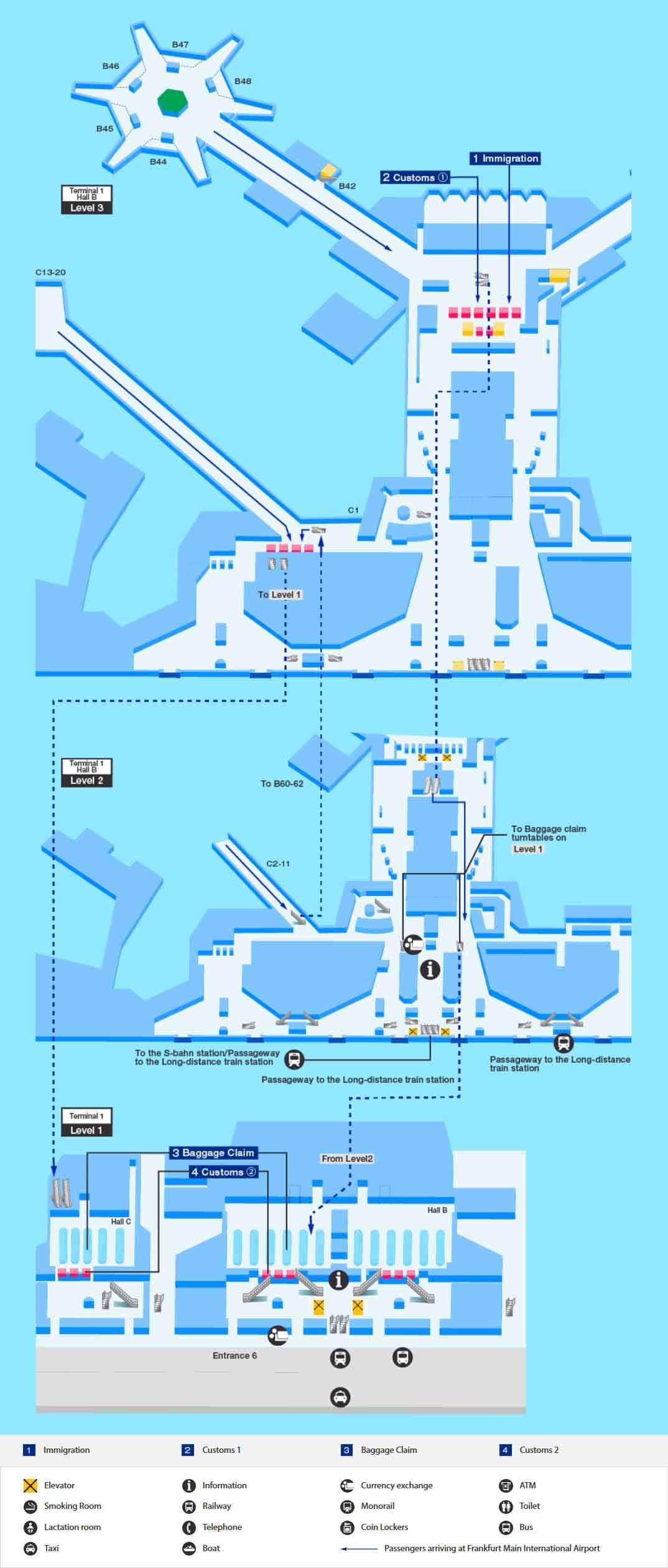
Airport Map Information
Flights operated by ANA group will arrive at Terminal 1 of Frankfurt Airport. On level 3 (Hall B) of Terminal 1, there are Immigration booths, Customs (1), escalators and elevators.
On level 2 (Hall B), there is an information counter, a currency exchange booth, the S-Bahn regional train station, a passageway to the long-distance train station, escalators and elevators.
On level 1, Halls C and B each have a baggage claim area and Customs (2). There is also an information counter, escalators and elevators. Near exit 6, there is a currency exchange booth, train station, bus stops and taxi stands.
Immigration
There is no requirement to have an entry card for Germany. See Special Guidance info on this page for details if traveling to and/or between Schengen countries.
Customs
Checked baggage will be inspected at Customs 1 and 2.
Unaccompanied Minors
- Letter of Consent is required for the travelers under the age of 18 entering and/or departing from Germany without parents/guardians.
- In accordance with German law, minors under the age of 18 entering and/or departing from Germany alone (including transit passengers) must prepare a consent letter signed by a parent/guardian.
- Applicable passengers should contact their nearest German embassy, consulate or honorary consul. If you are a German resident, please contact your nearest Federal Police office or relevant public institution.
- In addition to the above, passengers between 5 and 11 traveling alone are required to use ANA Junior Pilot program.
Departure Terminal

Airport Map Information
Flights operated by ANA group will depart from Terminal 1 of Frankfurt Airport.
The ANA check-in counters (678 to 681) are located in Hall B on level 2 of Terminal 1, close to Entrance 6. There is a tax refund counter nearby, an application counter for VAT refunds on checked baggage (Zoll)and an information counter.
Close to the boarding gate, there is the Lufthansa Business Lounge and the Lufthansa Senator Lounge as well as a smoking room. Get details on Frankfurt airport lounges.
Check-In
- Boarding gate check-in counters are subject to change; please check at the airport.
- See ANA International Airport Check-In Counter Opening Times.
VAT refunds
A value-added tax (VAT) is applied to items purchased in Germany or other EU countries, but visitors may apply for the refund of the tax.
- VAT refunds may not be provided by some shops, please check the shop for tax-free handling and process a Tax Refund Check.
- Show the purchased item, your passport, boarding pass and Tax Refund Check to the Customs official at departure and have the check stamped.
Fast Track Security Screening
Some travelers are eligible for Fast Track Security Screening. Travelers should look for the Gold Track signs.
Eligible Travelers
- First class
- Business class
- Diamond service members
- Platinum service members
- Super Flyers members
- Star Alliance Gold members
Transit
The free “SkyLine” shuttle service connects Terminal 1 and 2 in the airport.
- It takes about 1 minute to get from Terminal 1 (A, Z) to Terminal 1 (B, C).
- It takes about 2 minutes to get from Terminal 1 (B, C) to Terminal 2 (D, E).
- Lufthansa and Austrian Airlines use the same Terminal 1 as ANA.
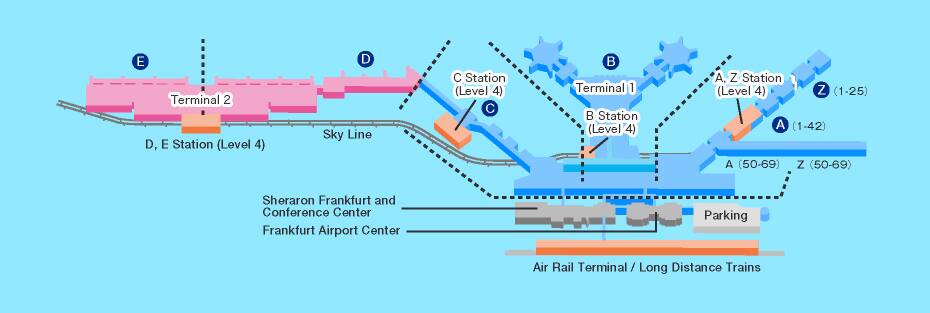
Airport Map Information
The SkyLine connects the different areas of Terminal 1 and 2. Stops A/Z, B, and C are located on level 4 of Terminal 1, while stop D/E is located on level 4 of Terminal 2.
Adjacent to Terminal 1 is the Sheraton Frankfurt Airport Hotel & Conference Center, the Frankfurt Airport Center, and parking lots, as well as a passageway to the AiRail Terminal and the long-distance train station.
Transiting from ANA to Other Airlines
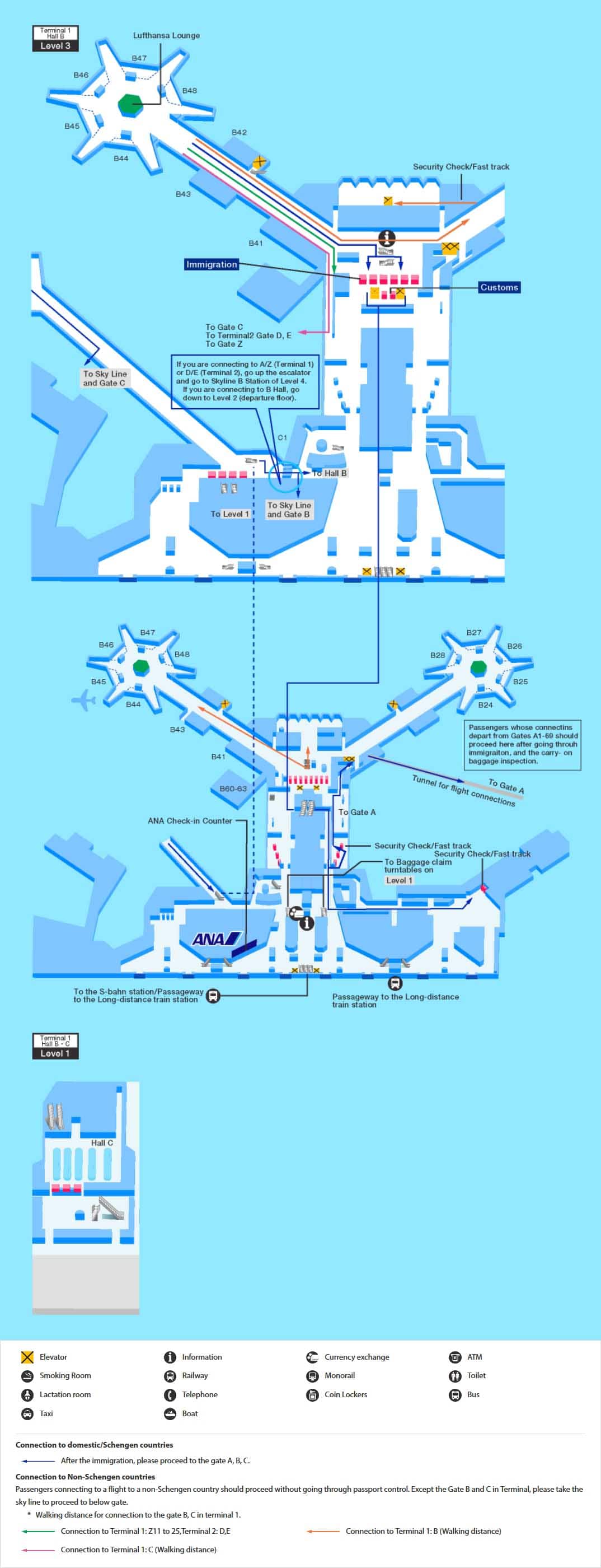
Airport Map Information
- On level 3, there is an information counter and the Lufthansa Lounge. Get more details on the Lounges.
- On level 2, there is a currency exchange booth, an information counter, ANA check-in counters, the S-Bahn regional train station, and the passageway to the long-distance train station, as well as escalators and elevators.
- On level 1 (Halls B/C) of Terminal 1, there is the baggage claim area.
Passengers connecting to Germany domestic flights or flights to a Schengen country should proceed to Immigration and Customs on Level 3 (Hall B) of Terminal 1.
- After passing through Immigration and Customs, passengers connecting to A/Z in Terminal 1 or D/E should take the escalator up to Skyline stop B.
- Passengers connecting from Hall B should go down to level 2 (departures).
- Passengers connecting to Gates A should pass through security or the priority security lane on level 2 and then proceed to Gates A.
- Note: When connecting to Gates A1 to 69, you must take the elevator down to the underground level and walk through the connecting tunnel to the gates.
- Passengers arriving at Gates C who are going to Hall A/Z or D/E should proceed to SkyLine stop C.
Passengers connecting to a non-Schengen country do not need to enter Germany.
- Passengers connecting to Gates B should go to level 3 to pass through security or the priority security lane, take the elevator down to level 2, and continue to the boarding gate.
- Passengers connecting to Gates C should go from level 3 to Hall C.
- Passengers connecting to Gates D/E in Terminal 2 or Z11 to 25 should take the SkyLine to the relevant stop.
Transiting from ANA to Other Airlines

Airport Map Information
Passengers connecting from a Germany domestic flight or a flight from a Schengen country should proceed to the ANA check-in counters (678 to 681) on level 2 (Hall B) of Terminal 1 to perform check-in procedures. After check-in, pass through security or the priority security lane, go through Immigration, and then continue to the boarding gate at Gates B40 to 48. Passengers arriving at Gates A1 to 69 should take the elevator next to A15 down to the underground level, walk through the connecting tunnel, and proceed to Gates B.
On level 2, there is also an information counter, the Lufthansa Business Lounge, the Lufthansa Senator Lounge, escalators and elevators. On level 3 (Hall B) of Terminal 1, there is an information counter, security and the priority security lane.
Passengers connecting from a non-Schengen country arriving at Gates D or E in Terminal 2 or Gates Z should take the SkyLine to Gates B or C in Terminal 1 without entering Germany, and then proceed to security.
Frankfurt
On August 27th, 2019 (JST) current information.
Furthermore, the details under "Visa" and "Passport" are for Japanese nationals.
This information is likely to change G:G
Germany
Official Language: German
Currency: Euro (EUR)
Time Zone: UTC +1 (CET)
Travelling to Germany?
Whether you’re connecting at the airport or will be exploring what this beautiful country has to offer, you’ll find all the helpful tips you need to know on this page—including the current exchange rate, climate information and more. For detailed country information, please visit the embassy’s website.
Immigration and Visa (For Japanese Nationals Only)
Visa
Not required for a tourism visit that is no more than ninety days in any 180-day period.
Passport
Your passport must be valid for at least three months from the date of departure from Germany or another country in the Schengen Area.
- * Schengen Agreement
As of April 2018, countries in the Schengen Area are Iceland, Italy, Estonia, Austria, Holland, Greece, Switzerland, Sweden, Spain, Slovakia, Slovenia, the Czech Republic, Denmark, Germany, Norway, Hungary, Finland, France, Belgium, Poland, Portugal, Malta, Latvia, Lithuania, Lichtenstein, and Luxembourg. When entering from Japan or another country outside of the Schengen Area, complete Immigration and Customs clearance upon arriving at the first country in the area during your visit. - * Visa, passport, and other information is subject to change without notice. Be sure to check with the Embassy, Consulate, or travel agency.
Quarantine
When visiting from Japan, it is prohibited to bring the following items into Germany.
- a. Meat, meat products (ham, sausages, or other processed foods containing meat)
- b. Milk, dairy products (up to 2 kg of powdered baby formula or baby food for personal use is permitted)
- c. Eggs
- d. Vegetables
- e. Fruit (including grape vines)
- f. Specified nutritional supplements (e.g. large quantities of vitamins or ginseng)
- * The types of controlled items may change depending on circumstances such as contagious disease outbreaks.
Customs
Bringing in e-cigarettes
E-cigarettes and e-liquid cartridges can be brought into the country as long as they are for personal use. However, they must be brought back to Japan after your trip. Travelers who are flying may bring up to 430 EUR worth of e-cigarettes and e-liquid cartridges.
For bringing and possession of tax-free cigarettes
This applies to travelers aged 17 and older at the time of entry by air. It is subject to all baggage in the possession of travelers and is limited to items for personal use.
- Tobacco: 200 cigarettes, 50 cigars, 100 slender cigars, or 250g of pipe tobacco. Possession of tobacco ranging over several types of the above are exempt up to a total weight of less than 250g.
- Liquor: 2L of wine or liquor containing under 22% alcohol, or 1L of liquor containing over 22% of alcohol.
- Other: Goods or merchandise purchased outside the EU, in value up to €430 equivalent.
- * You are required to make a Customs declaration if you bring any of the above items into the country (e.g. an expensive computer, camera, watch, or brand-name product that exceeds the tax exemption amount) or bring €10,000 or more into or out of the country. For more details, please check section on the Customs procedure for entering Germany on the website (Japanese and German only) for the Embassy of Germany in Japan (https://japan.diplo.de).
Time difference and Daylight Saving Time
Time difference
Japan is 8 hours ahead of Frankfurt. However, there is daylight saving time in Germany from the final Sunday of March to the final Sunday of October. During this period, the time difference between Japan and Frankfurt is 7 hours.
Climate
Climate
Germany has extremely cold winters. Even Munich in the south is further north of Sapporo. Therefore, when considering what to wear, it is best to bring clothing suitable for temperatures slightly colder than Hokkaido. Though in some years, there are heat waves in the summer, there are also quite cool days when it rains, so cold-weather garments such as cardigans should be brought.

Temperatures in Frankfurt and Tokyo

Precipitation in Frankfurt and Tokyo
Currency and Exchange Rate, Tax, Currency exchange, Tip
Currency and Exchange Rate
The unit of currency is the Euro (abbreviated as €, EURO, or EUR), which is divided into cents. They are read in German as Euro and cent. €1 is 100 Cent, approx. JPY118 (as of August 2019).
There are seven denominations of banknotes: €500, €200, €100, €50, €20, €10, and €5. There are eight types of coins: €2, €1, 50 cent, 20 cent, 10 cent, 5 cent, 2 cent, and 1 cent.

Note: Starting in 2013, new designs for banknotes are being introduced, beginning with small denominations.
Tax
In Germany, a value-added tax called “Umsatzsteuer” (abbreviated USt) of 19% is applied to almost all products. It is 7% for books and foods. Travelers can get this tax refunded if they do the paperwork (up to 14.5%). Incidentally, it is the tax paid when shopping that is refunded. Taxes paid for hotel and restaurant fees are not refunded.
Tip
Fees charged in places such as restaurants and hotels include a service charge, so a tip (called “trinkgeld” in German) is not always required. However, there is a custom of tipping to show gratitude to the person providing a service. The amount differs depending on whether a special request was made or the level of satisfaction with the service, but the following values serve as references.
- Taxis: Approx. 10% of the fare. Tip a little generously when there is a lot of luggage to put in the trunk.
- Toilets: Approx. €0.20 to €0.50 if there is an attendant sitting in the restroom with a plate in front of him/her.
- Restaurants: Though it depends on the quality of the restaurant, generally a tip that is 10% of the meal charge that is nicely rounded off is given when paying at the table, or change from the bill is left at the table.
- Hotels: Approx. €1 for the bellhop or when asking for room service.
Voltage and plug
Voltage
Voltage is 230V with a cycle of 50Hz. Plugs are generally Type C, though some are Type SE. Many electric products made for use in Japan cannot be used as is. A transformer is necessary.

Type C
Video and DVD
Video and DVD
The TV and video system in Germany (PAL) differs from Japan (NTSC), so DVD or other media from Germany cannot be played on ordinary video players in Japan. If a DVD displays the same region code as Japan (2), then it can be played on a computer equipped with a DVD player as it is normally compatible with PAL output, but the DVD cannot be played on ordinary DVD players (it is possible if the machine is compatible with PAL).
Post offices in Germany are privatized establishments called Deutsche Post AG. In addition to postal services, many also sell stationery, etc. There are also counters in corners of train stations and shopping centers.
Normal Business Hours
Mon. to Fri. 8:00 to 18:00 and until 12:00 on Sat., closed on Sun., holidays. However, it differs. For example, small post offices close for lunch and the post office in the central train station of large cities are open until late at night.
Postal Fees
Airmail to Japan costs €0.90 for a postcard and €0.90 for a sealed letter up to 20g. Small packages up to 2kg called a "päckchen" can also be sent for €16, and a parcel called a "paket" is €46.99 up to 5kg.
Phone Call
Telephoning Japan from Germany
- Dial 00 (International telephone ID Number)
- 81 (Country Code, Japan)
- X X(Remove the first 0 for area codes and mobile telephone numbers)
- 1234-5678 (Other parties telephone no.)
Telephoning Germany from Japan
- International Telephone Provider No.
- 001 (KDDI)*1
- 0033 (NTT Communications) *1
- 0061 (SoftBank Telecom) *1
- 005345 (au Mobile) *2
- 009130 (NTT DoCoMo Mobile) *3
- 0046 (SoftBank Mobile)*4
- 010 (International Identification No.)
- 49 (Country Code, Germany)
- X X (Remove the first 0 for area codes)
- 123-456 (Other parties telephone No.)
-
*1.Not required if you have an international registration with "My Line" or "My Line Plus". See URL My Line/My Line Plus(www.myline.org) for details.
-
*2.au does not require 005345.
-
*3.Pre-registration to World Wing is required for NTT DoCoMo. Does not require 009130.
-
*4.Call are possible without dialing 0046 from SoftBank.
Calling from within Germany:
Not required when calling within the area. Area codes are required when calling between regions.
Using Public Telephones:
- Lift the receiver of its hook.
- Insert a telephone card according to the directions shown on the card.
- Dial the other parties telephone number.
- The remaining balance on the telephone card will be shown on the screen. After finishing the telephone call, place the receiver back on its hook and retrieve the telephone card.
Holiday / National holiday
Holiday / National holiday
There are many national holidays related to Christianity. Note that some national holidays fall on different days, depending on the year. There are also public holidays exclusive to certain states.
2020
- January 1: New Year's Day
- January 6: Epiphany*2
- April 10: Good Friday*1
- April 12: Easter Sunday*1
- April 13: Easter Monday*1
- May 1: May Day
- May 21: Ascension Day*1
- June 31: Whit Sunday*1
- June 1: Whit Monday*1
- June 11: Corpus Christi*1 *2
- August 15: Assumption Day*2
- October 3: Day of German Unity
- October 31: Reformation Day*2
- November 1: All Saints' Day*2
- November 18: Day of Atonement*1 *2
- December 25, 26: Christmas
-
*1.National holidays fall on different days, depending on the year.
-
*2.Public holidays exclusive to certain states.
Language
Language
German
Business hours, etc
Business hours
Below are guidelines for general business hours, which differ by shop around 30min. to an hour.
Banks
Differs by bank, but generally Mon. to Fri. 9:00 to 12:00 and 14:30 to 16:00 (until 17:30 on Thu.), closed on Sat., Sun., holidays.
Department Stores/Shops
Mon. to Fri. 9:00 to 20:00, Sat. 9:00 to 16:00 (until 18:00 in large cities and during the Christmas season).
Restaurants
Lunch is from 11:30 to 14:00, dinner from around 17:30 to 23:00.
Age Limit
In Germany, alcohol is prohibited for those under 16 (under 18 for spirits) and smoking is prohibited for those under 18.
Age limitations for rental cars depend on the rental company and vehicle type.
Manners
In Germany, greetings are important. When entering a store or restaurant, the clerk or waiter is greeted with “Guten Tag,” “Danke” is said when being served, and “Tschüß” is said when leaving. The attitude of persons serving visitors changes just by observing these Customs.
Copyright (C) Globe-Trotter Media Partners Inc. All Rights Reserved.
Copyright (C) Diamond-Big Co., Ltd. All Rights Reserved.
Traveling Between Schengen Countries
The establishment of the EU and the Schengen Agreement has simplified entry and departure procedures within Europe. Once a Japanese national has arrived at one of the Schengen countries, travel within that country is treated as “internal domestic” travel. The following entry and departure procedures apply to passengers traveling from one Schengen country to another Schengen country.
- Entry:
- Taken only in the first country of arrival.
- Customs inspection for carry-on baggage is made at the first country of arrival and at the final destination for checked-in baggage.
- Departure:
- Taken only in the last Schengen country to be departed from.
- The Customs inspection is made at the destination country.
Note: Entry/departure procedures may take an extended amount of time if the passenger does not possess a letter of consent. This letter does not guarantee permission to enter and/or depart from the country, since this is at the discretion of Immigration officer.
Visa
Passengers who plan to obtain their visa after their arrival in a Schengen country other than Germany will need a Schengen visa when going through Immigration in Germany. Passengers to whom this condition applies should inquire with their nearest German embassy or consulate.