


Traveling to and from Vancouver
On this page, you will find the information you need to easily make your way through Vancouver International Airport and to your destination.
Guide to Vancouver International Airport
Arrival and departure terminal maps and other information for navigating Vancouver airport.

Arrival Terminal

Airport Map Information
Flights operated by ANA arrive on the 2nd floor of Vancouver’s International Terminal. On that floor, there are Immigration booths, baggage claim area, and counter number 35, where special items, such as oversize baggage, sports equipment and baby strollers, are returned.
After passing through Customs, go to the 3rd floor (domestic departures). There also are information counters, a currency exchange booth, a baggage counter and elevator for passengers connecting to Air Canada flights, and a counter for passengers connecting to WestJet Airlines.
On Arrival
Upon arrival, all passengers should present your passport, Immigration card, and any required entry documents. See the Special Guidance tab on this page for special Immigration rules for passengers entering Canada from abroad.
Special Travel Rules for Children
Children Under Age 5
Canadian law requires that children under age 5 be accompanied by a person age 16 or older. The child will not be permitted to board if the presence of an accompanying passenger cannot be confirmed.
Children Under Age 14
Canadian regulations require every effort by airlines to facilitate assignment of seats to keep kids under 14 in proximity to their adult travel companions. The proximity of the seats depend on the child's age.
Departure Terminal

Airport Map Information
On the 3rd floor of the International Terminal, you will ANA check-in and ticketing counters, security and the priority security lane. After passing through security, you can visit the Plaza Premium Lounge.
ANA Mileage Club members and others may access the airport lounge in anticipation of departure. Get details on the Vancouver airport lounge.
Fast Track Security Screening
Some travelers are eligible for Fast Track Security Screening. Travelers should look for the Fast Track signs.
Eligible Travelers
- Business class
- Diamond service members
- Platinum service members
- Super Flyers members
- Star Alliance Gold members
Transit
Transfer from ANA to other airlines (domestic flights)
After going through Immigration and baggage claim, proceed to Customs past the Canada Connection display. Submit your Customs Declaration Form, then check-in your baggage at the Baggage conveyor of Air Canada. Then go up to the 4th floor and proceed to the Air Canada connecting counter.
After completing the arrival procedures, proceed to the 3rd floor to the "Canada Flights" area, then go to the check-in counter of the connecting airline.
- The connecting counter of WestJet Airlines is located at the International Arrival Lobby (on the 2nd floor).
Transfer from ANA to other airlines (international flights)
Connecting to the U.S.
If your bags were checked through to the final destination—indicated on the luggage tags—you do not have to pick them up at Vancouver Airport. Please follow the sign for USA Connections.
- The airport staff will provide a disembarkation form for those traveling to the U.S. Please completely fill out before arrival.
- If check-in is necessary, please do so by either using an automated check-in machine or at the transfer desk. Once you go through security, proceed to Customs and passport control for the U.S.. Once you’re through that, go to the boarding gate for your connecting flight.
- If the departure of your connecting flight is 8:31 p.m. or later, please follow the instructions for connecting to flights other than the U.S.
Connecting to flights other than the U.S.
If your bags were checked through to the final destination—indicated on the luggage tags—you do not have to pick them up at Vancouver Airport. Please follow the sign for International Connections.
- Present your passport and Customs Declaration Form for Canada at the connecting inspection site. Then, proceed to the boarding gate for your connecting flight.
Transfer from other airlines to ANA (domestic flights)
Follow the signs for International Connections, then proceed to the boarding gate with your boarding pass.
Transfer from other airlines to ANA (international flights)
Follow the signs for International Connections. Please present passport, Customs Declaration Form and boarding pass at the connecting inspection site. Then, follow the signs to the designated boarding gate.
Vancouver
On December 19th, 2019 (JST) current information.
Furthermore, the details under "Visa" and "Passport" are for Japanese nationals.
This information is likely to change suddenly, so please contact the relevant official authority (e.g., embassy) for the latest information.
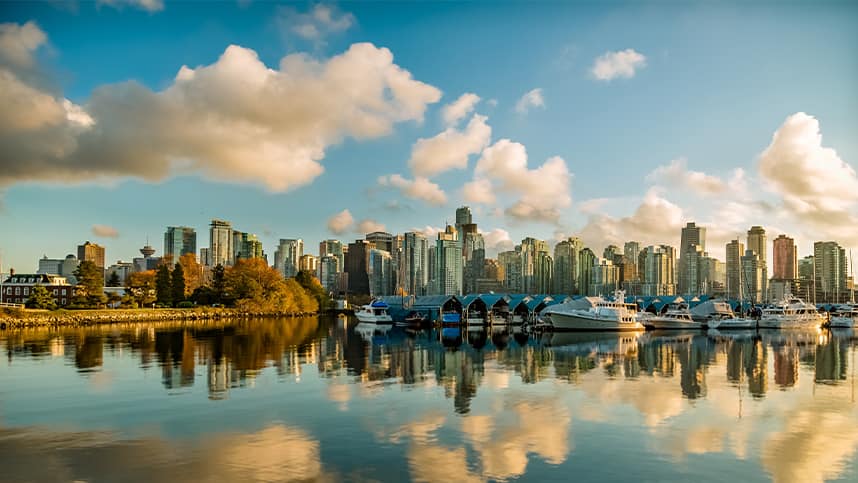
Canada
Official Languages: English, French
Currency: Canadian Dollar ($)
Time Zone: UTC -8 (Pacific Standard Time)
Traveling to Canada?
Whether you’re connecting at the airport or will be exploring what this beautiful country has to offer, you’ll find all the helpful tips you need to know on this page—including the current exchange rate, climate information and more. For detailed country information, please visit the embassy’s website.
Immigration and Visa (For Japanese Nationals Only)
Visa
No visa is required for a stay of up to six months for tourism or business. From March 15, 2016, you are required to have an eTA.
Passport
Your passport must be valid until at least one day following the scheduled date of departure from Canada.
Note for travel to Canada
eTA:
From March 15, 2016, you are required to have an Electronic Travel Authorization (eTA) when traveling to Canada by plane. It costs $7 and is valid for five years. If your passport expires during that period, it is valid until the expiration date. You can apply for an eTA online, and you must give your passport and credit card information and e-mail address. It only takes a few minutes, but you should apply as early as possible. The application procedure is only in English, but information is also available in Japanese. It is also required when stopping in Canada in transit on your way to another country. Government of Canada's website, Japanese information on Government of Canada's website.
Note for travel to Canada via the United States
ESTA:
The Electronic System for Travel Authorization (ESTA) was introduced in 2009 for those wishing to travel to the United States without a visa. To use this system, you must apply for travel authorization in advance. Applications must be submitted at least 72 hours before departure on the official ESTA website(https://esta.cbp.dhs.gov/) . Follow the procedure in Japanese, and enter the applicant information, passport information, travel information, address during your stay in the United States (e.g. your hotel), and other details in the roman alphabet. The application fee is $14. You can pay by American Express, MasterCard, VISA, or other credit card or by debit card.
- * Visa, passport, and other information is subject to change without notice. Be sure to check with the Embassy, Consulate, or travel agency.
Quarantine
When visiting from Japan, it is prohibited to bring the following items into Canada.
- a. Live or cooked meat, fruit, vegetables, milk, and other food products
- b. Plants, processed products made from wood, woodchips, foliage plants, firewood, seeds, and other plants
- c. Soil or shoes covered in dirt
- d. Live animals including pets
Customs
Bringing in e-cigarettes
Exemption for tobacco sticks is up to 200 sticks, same as regular cigarettes.
If you want to enter in less than 18 years of age
If a traveler under 18 years of age is entering Canada, documents may be required at the time of entry regardless of the presence of a traveling companion. Please verify details on the Embassy of Canada website.
For bringing and possession of tax-free cigarettes
- Alcohol: any one of the following: wine 1.5L, beer 8.5L or other 1.14L
- Tobacco: any one of the following: 200 cigarettes, pipe tobacco 200g or 50 cigars
Time difference and Daylight Saving Time
Time difference
There are 6 time zones in Canada. There is a difference of 4.5 hours between the far-eastern Newfoundland Standard Time and far-western Pacific Standard Time. Newfoundland Standard Time is 3.5 hours behind Greenwich Mean Time (GMT). Vancouver is 12.5 hours behind Japan.The time difference will increase by one hour as you cross each time zone moving from east to west. (The time difference to Japan becomes larger.) Daylight saving takes place from the second Sunday of March to the first Sunday of November, when clocks move forward by one hour.
Climate
Climate
Because of its expansive land area, Pacific coastal areas like Vancouver have a large volume of rain. The cold of the Canadian Rockies is very harsh and a jacket is required even in summer if the weather turns. There is a huge temperature difference between warm and cold in Calgary and other places in the prairies. The area around the Great Lakes has four distinct seasons. Areas further East have cool summers and relatively warmer winters. The Far North region around the Arctic Circle is very cold all year round.


Currency and Exchange Rate, Tax, Currency exchange, Tip
Currency and Exchange Rate
The currency used is the Canadian Dollar; abbreviated as $ or C$ (CAD). Cents (¢) are used as fractional currency. $1 is¢100, approx. 82 yen (as of December, 2019). The five types of notes issued are $5, 10, 20, 50 and 100. Both the old notes and new notes are in use. The five types of coins issued are 5, 10, 25 (quarter), $1 (loonie) and $2.

Tax
Products, accommodation fees, meals, and services etc. are subject to 5% federal Goods and Services Tax (GST) as well as Provincial Sales Taxes, Yukon, the Northwest Territories, and Nunavut have only GST. Ontario has only 13% Harmonized Sales Tax (HST) and Prince Edward Island, New Brunswick, Newfoundland, Labrador, and Nova Scotia have only 15% HST. In Canada, prices for commodities and accommodation are not shown with tax included. Some cities and towns in the different provinces and territories have a separate 2-4% accommodation tax or additional fee of about $3. These taxes and fees are higher in large cities and tourist areas.
Tip
It is customary to leave a tip of approximately 10 to 15% when paying for food at a restaurant or for a taxi. A tip is not required when a service charge is included as part of the bill.
Voltage and plug
Voltage
110V to 120V, 60Hz. Power sockets are almost equivalent to Japan's and uses type A. Since the difference in voltage compared with Japan is only 10 to 20V, most electronic appliances from Japan such as hair dryers and shavers can be plugged in and used as is. Computer related devices can be used without any issues.

Video and DVD
Video and DVD
Canada, like Japan, uses the NTSC standard. Video software brought from Japan can be played smoothly. However, DVDs cannot be played due to the difference in region code (Japan: Region 2, Canada: Region 1).
Blu-ray system
The Blu-ray Disc region code is A in both Japan and Canada, so Canadian media can be played normally on Japanese media players and vice versa.
Postal Charge
When mailing to Japan, airmails including postcards and standard size mails up to 30g are all $2.65. Stamps can be purchased at the post office, as well as at a hotel's front desk and kiosks at a train station, airport or bus depot. The number of days it takes before arrival in Japan differs depending on from where it was mailed, but airmails generally take one to three weeks.
Business Hours
Most post offices are what is called the Postal Outlet inside places such as drugstores, and generally operate from Monday to Friday, between 9:00 to 17:00, Saturday 10:00 to 14:00, and are closed on Sundays. Some places are closed on Saturdays.
Phone Call
Telephoning Japan from Canada
When calling Tokyo (03) 1234-5678:
- dial 011 (International telephone identification number)
- 81 (Country Code, Japan )
- 3 (Remove the first 0 for area codes)
- 1234-5678(Other parties telephone number)
Telephoning Toronto from Japan
When calling Toronto (416) 123-4567:
- International Telephone Company No.
- 001 (KDDI)*1
- 0033 (NTT Communications) *1
- 0061 (SoftBank Telecom) *1
- 005345 (au Mobile) *2
- 009130 (NTT DoCoMo Mobile) *3
- 0046 (SoftBank Mobile)*4
- 010 (International Identification No.) *2
- 1 (Country Code, Canada)
- 416(Area code)
- 123-4567 (Other parties telephone number)
-
*1.Not required if you have an international registration with "My Line" or "My Line Plus". See URL My Line/My Line Plus(www.myline.org) for details.
-
*2.au does not require 005345.
-
*3.Pre-registration to World Wing is required for NTT DoCoMo. Does not require 009130.
-
*4.Call are possible without dialing 0046 from SoftBank.
- * For the three cell phone carriers, hold down 0 until + appears, then add the country code and the phone number your wish to dial.
Holiday / National holiday
Holiday / National holiday
In addition to national holidays, there are also state established holidays. The following are holidays for 2020.
- January 1: New Year's Day
- April 10: Good Friday*1
- April 13: Easter Monday*1
- May 18: Queen Victoria's Birthday*1
- July 1: National Foundation Day (Canada Day)
- September 7: Labor Day*1
- October 12: Thanksgiving Day*1
- November 11: Remembrance Day
- December 25: Christmas Day
- December 26: Boxing Day
-
*1.Movable holidays
Language
Language
The two official languages established by Canada are English and French. English and French are spoken as first languages by approximately 57% and 22% of the population respectively. Some states establish different official languages. Aboriginal languages are established as the official languages in the Far North.
Business hours, etc
Business hours
General business hours are as below. There may be a difference of roughly 30 minutes to 1 hour by store.
Banks
Normally from Monday to Friday, between 9:30 to 16:00. Closed on Saturday, Sunday and holidays.
Department Stores and Shops
Monday to Friday between 10:00 to 18:00 (many places are open until 20:00 on Thursdays and Fridays). Open during evenings in areas such as Banff. Shopping centers in suburbs may be open on Sundays.
Liquor Stores
Monday to Saturday, between 9:00 to 18:00. May be open on Sundays in urban areas or during the summer season, and some may be open until around 21:00.
Age Limit
Smoking by persons under 18 years of age, as well as alcohol consumption and casino gambling by persons under 19 years of age (18 for Alberta, Manitoba, Quebec) are prohibited.
In general, rental cars are allowed for persons 25 years of age or over. If under 25 years of age, rent may be denied or may be charged a separate fee.
Smoking
Smoking and alcohol consumption in public places are fully prohibited, with a few exceptions. Restaurant and bars are all non-smoking.
Copyright (C) Globe-Trotter Media Partners Inc. All Rights Reserved.
Copyright (C) Diamond-Big Co., Ltd. All Rights Reserved.
Before Traveling to Canada
What you need to know about special requirements for travelers entering Canada.
Electronic Travel Authorization (eTA) Application for Entry into Canada
All visa-exempt foreign nationals traveling to Canada must obtain Electronic Travel Authorization (eTA). This applies to those visiting Canada and those entering an airport in Canada for transit to other countries. You must have the eTA when checking in for any flight to Canada.
Customers Who Require an eTA
Non-Canadian or U.S. citizens who do not require a visa to enter Canada must obtain an eTA number before entering the country by air.
- Travelers entering Canada by land or sea do not require an eTA.
Permanent residents of Canada do not need an eTA when entering Canada by air, but you must carry your Canadian permanent residency (PR) card or your permanent resident travel document (PRTD) with you. Failure to have it could result in being barred from your flight bound for Canada.
Permanent residents of the United States are required to have an eTA to enter Canada by air and to carry your Green Card with you.
- You will not need an eTA if you enter Canada by land or sea.
International Students/Temporary Workers from countries where an eTA is required must apply for an eTA if they are planning to travel by air from and return to Canada by air.
How to Apply
Complete the application for an eTA here: eTA Application Site
- There is a $7 CAD fee.
- You will be notified by email if you have been approved.
Although it is possible to apply for an eTA immediately before traveling to Canada, the Canadian government recommends completing the application when you begin making your travel plans.
Notes
- The eTA is valid for five years.
- If your passport is due to expire within five years, your eTA will remain valid until the expiration date on your passport.
- You may re-enter Canada as many times as you wish within the period of validity of your eTA.
Primary Inspection Kiosks
The Vancouver Airport is equipped with primary inspection kiosks to save you time going through Customs and Immigration. You can save even more time by completing your declaration in advance using the eDeclaration mobile app. For more on this, visit Canada Border Services Agency.
Paperwork may be required for travelers under 18 entering Canada, whether traveling with others or unaccompanied. For details, see the Official Website of Canada Embassy.
- Passengers who plan to travel to the Canada must get pre-travel authorization though eTA by themselves before departure. See ANA’s Electronic System for Travel Authorization.
Enhanced Baggage Inspections
The Canada Transportation Security Administration may open some checked bags for a physical inspection if there is something suspicious detected in the bag.
- Locked bags may be opened forcibly by security inspectors without the owner or the operating airline being informed.
- ANA will not be liable for any damage (including damaged locks).
- High-value items should be packed in carry-on baggage.
- Be aware that the enhanced security equipment could damage undeveloped film. You should store film in your carry-on bag.
- Please do not pack camera film in checked baggage, as the enhanced security equipment being used for security might damage them. They should be brought into the cabin as carry-on baggage.