


Traveling to and from Chennai
On this page, you will find the information you need to easily make your way through Chennai International Airport to your destination.
Guide to India’s Chennai International Airport
Arrival and departure terminal maps and other information for navigating India’s Chennai International Airport.

Arrival Terminal
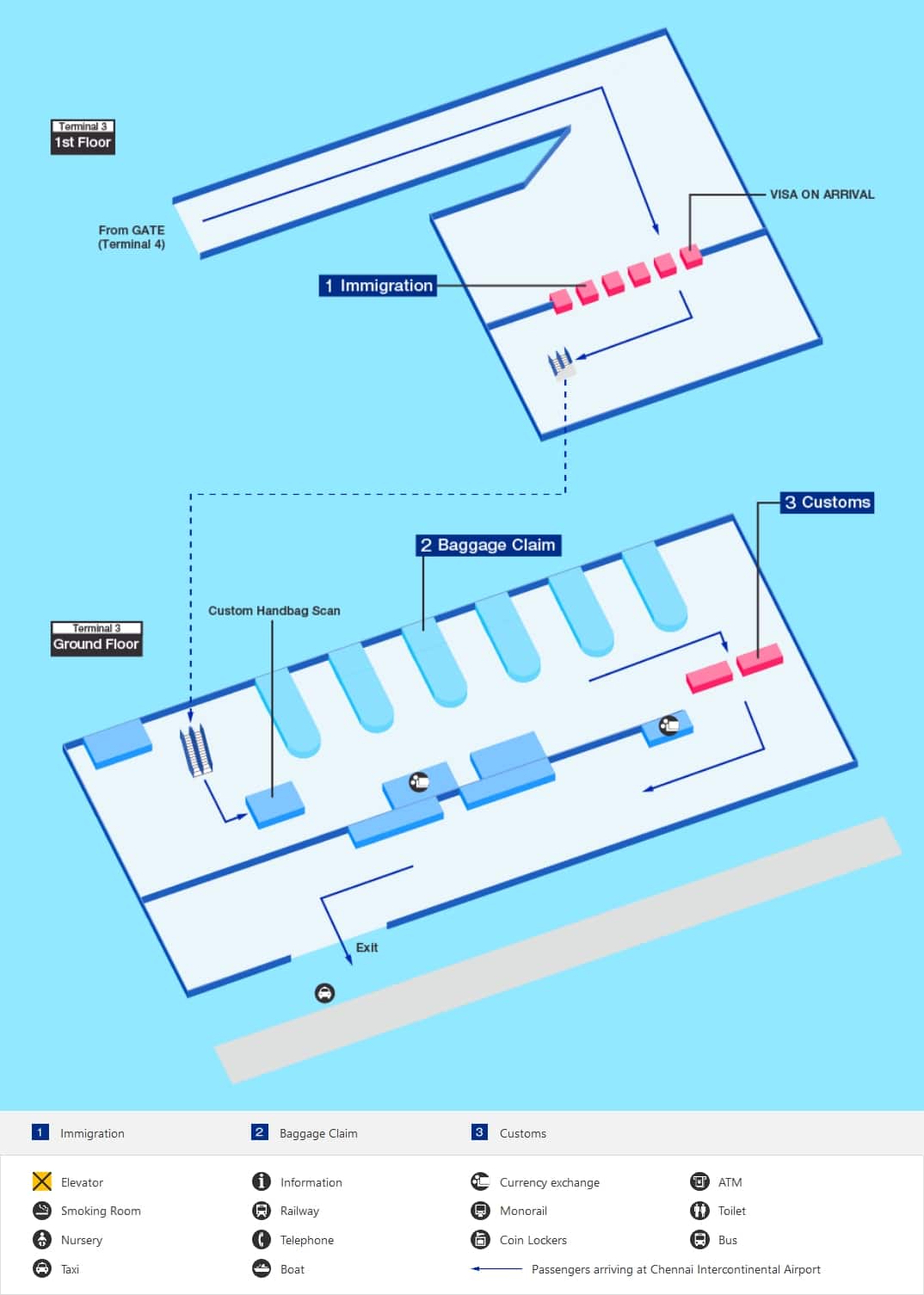
Airport Map Information
ANA-operated flights will arrive at Terminal 3 of Chennai Airport.
Immigration
- Please present your passport and Immigration Card.
- Those who do not carry an Indian passport (including people of Japanese nationality) must present the Immigration Card.
- You may be asked to present your boarding pass as well. For information around visas, please visit the Special Guidance section on this page.
Customs
Customers with goods to declare should submit a Customs Declaration forms.
Departure Terminal

Airport Map Information
Flights operated by the ANA Group will depart from Terminal 4. Get details on the Airport Lounge.
Terminal Access
- Only the passengers boarding flights can enter the international terminal.
- Passengers cannot enter the terminal earlier than three hours before flight departure time.
- At the entrance of the terminal, all passengers are asked to present the boarding pass with flight number of the day printed, Electronic Ticket Itinerary/Receipt and the passport.
- Any reservation changes (such as rebooking) are required beforehand.
- At the terminal entrance, you must present a flight ticket or e-Ticket Itinerary Receipt indicating a flight departing on the same day, as well as your passport.
- If you wish to change your reservation, please complete the necessary procedures at an ANA city ticketing counter and bring your ticket with you to the airport.
- In the case of an e-ticket, please print and bring the Electronic Ticket Itinerary/Receipt with the updated departing date.
Check-In
- Since the boarding gate check-in counters might be subject to change, please check at the airport to the day of departure.
- See ANA International Airport Check-In Counter Opening Times.
Immigration
- Please present your passport and boarding pass.
- Passengers without Indian nationality (including Japanese nationals) are not required to submit an immigration card.
Baggage Restriction
Note: The MacBook Pro15 is not allowed on any flights traveling from India, as per the Director General of Civil Aviation (DGCA/INDIA). The MacBook Pro15 contains a battery that may overheat and was recalled due to the potential fire hazard. The laptop was primarily sold between September 2015 and February 2017. Any passengers who own this laptop are kindly requested to make alternative arrangements. For more details, please visit the Directorate General of Civil Aviation website.
Transit
Connecting from ANA to Other Airlines (India Domestic Flights)
- Please pick up your baggage upon arrival and proceed to the departure lobby for India domestic flights on the 2nd floor of Terminal 1.
- Some India domestic flights operated by AI or 6E will depart from Terminal 4. Please proceed to the check-in counters for India domestic flights on the 2nd floor of Terminal 4.
Connecting from ANA to Other Airlines (International Flights)
- Airline staff will keep hold of your passport and boarding pass and perform the necessary procedures on your behalf.
- Even if you have a boarding pass, staff will have to guide you through security. Note: They may keep your passport and boarding pass for an extended period of time until check-in starts for the connecting flight. Thank you for your understanding.
Connecting from ANA to Other Airlines (International Flights)
- If you’ve already checked in to your connecting flight, go through the transfer security checkpoint and proceed to the boarding gate for the connecting flight.
- If you have not checked in for the connecting flight, please check in at the transfer counter and proceed to the boarding gate.
Passengers connecting from other airlines to ANA (Domestic Flights)
- Please exit the arrival area for India domestic flights and proceed to the check-in counters for international flights on the 2nd floor of Terminal 4.
Chennai
On September 27th, 2019 (JST) current information.
Furthermore, the details under "Visa" and "Passport" are for Japanese nationals.
This information is likely to change suddenly, so please contact the relevant official authority (e.g., embassy) for the latest information.
Republic of India
Official Languages: Hindi, English
Currency: Rupee (INR)
Time Zone: UTC +5.5 (IST)
Travelling to India?
Whether you’re connecting at the airport or will be exploring what this beautiful country has to offer, you’ll find all the helpful tips you need to know on this page—including the current exchange rate, climate information and more. For detailed country information, please visit the embassy’s website.
Immigration and Visa (For Japanese Nationals Only)
Visa
There are various types of visas for visiting India, such as tourist, business, or studying, and a tourist visa is required if you want to enter the country for the purpose of travel. As of March 2017, there are three patterns for obtaining a tourist visa.
- Regular visa: This is a regular visa obtained in advance in another country outside of India. The type of visa obtained in Japan is a multiple-entry tourist visa with unlimited re-entry in the six months from the date issued.
In Japan, you can apply for such a visa at the Indian Embassy. Click the Indian Embassy website for details about how to apply for a visa. - e-tourist visa: This is a visa that is issued at the airport upon arrival. You must enter the required information on the Internet at least 4 days prior to your departure and bring a printout of your application. You can only enter the country twice, and it is valid for 60 days from the day of arrival. Use the application form on the website Government of India.
- Arrival visa: There is no need for application in advance, and it is issued at the airport in India. It is a double entry visa that allows entry into the country twice over a 60-day period.
- * The arrival visa program for Japanese people changed on April 1st, 2017. For details, click the Indian Embassy website.
Passport
Your passport must be valid for at least six months from the date of visa application, and must have at least two unused visa pages.
- * For the latest information, be sure to check the website of the Embassy of Japan in India.
- * Visa, passport, and other information is subject to change without notice. Be sure to check with the Embassy, Consulate, or travel agency.
Quarantine
When visiting from Japan, it is prohibited to bring the following items into India.
- a. Meat and all meat products
- b. Marine product and processed marine products
- c. Egg products
- d. Milk products
- e. Pet food
- f. Products made with bird feathers or pig fur
- g. Processed bone or horn products
- h. Plants, seeds, fruit, fresh flowers
- i. Live birds, animals (including pets)
- j. Plants or animals that are at risk of extinction (alive or dead)
- k. Products made from wild animals
- * As a rule, small amounts of food or other items for personal use may be confiscated unless officially approved.
Customs
Bringing in e-cigarettes
Prohibited from bringing in. In September 2019, the Indian government prohibited all production, sale, and import of e-cigarettes. Foreign nationals may also be penalized.
For bringing and possession of tax-free cigarettes
- Tobacco: 100 cigarettes, 25 cigars, or 125g of cut tobacco
- Liquor: up to 2L regardless of the type of liquor
- Gifts equal to less than Rs8000
Time difference and Daylight Saving Time
Time difference
India has a single time zone. Time difference: Japan is 3.5 hours ahead of India. (It is 8:30AM in India when it is noon in Japan.) There is no daylight saving in India.
Climate
Climate
The climate is hot and humid all year round. The temperature from April to June is close to 40°C with constant high humidity. The temperature drops slightly from July to September. During the monsoon season from October to December, the heat is more bearable, with temperatures at or lower than 30°C.
Currency and Exchange Rate, Tax, Currency exchange, Tip
Currency and Exchange Rate
The unit of currency is the rupee (Rs) and paisa (P). In Hindi, they are called rupaya (the plural is rupaye) and paisa (the plural is paise). Rs1 = P. As of September 4, 2019, Rs1 equaled approx. JPY1.5.
There are ten denominations of banknotes: Rs1, Rs2, Rs5, Rs10, Rs20, Rs50, Rs100, Rs200, Rs500, and Rs2000. There are nine types of coins: P5, P10, P20, P25, P50, Rs1, Rs2, Rs5, and Rs10. However, of those, the Rs1 and Rs2 banknotes and P5–P50 coins are almost never used.

Tax
Goods and services tax (GST) was implemented in July 2017. The tax rate varies by the type of article. Also, depending on the article(s) purchased, taxes other than GST may also apply. For hotels, taxes apply for accommodation expenses amounting to Rs1,000 or more.
Tip
- Hotels: It is good manners to tip when having luggage carried or asking for room service. A rule of thumb is Rs30 for mid-level hotels and approx. Rs40 to Rs50 per piece of luggage at luxury hotels.
- Restaurants: Tipping is not required when included in the service charge, but in other cases a tip of approx. 5 to 7% of the meal charge should be left. However, at restaurants serving locals it is okay to leave change from the bill as a tip, and even that is optional.
- Other: A tip of approx. Rs100 or more per tourist should be given to a guide who provides individual guidance or when arrangements are made for a car.
Voltage and plug
Voltage
Voltage is 220V to 240V with a cycle of 50Hz. Plugs are most commonly Type B3, BF, B, and C.

Video and DVD
Video and DVD
When purchasing VHS, VCD, DVD, and BD, take note of the broadcasting system (Japan is NTSC; India is PAL) and region code (DVD is 2, BD is A in Japan; DVD is 5, BD is C in India). To play PAL, a device is needed that can switch to NTSC. The code must be the same for video and player, or one of them must be compatible with all regions for it to be played.
Postal Fees
Airmail to Japan costs Rs15 for a picture postcard, Rs25 for a sealed letter. Airmail takes 4 days to 10 days to be delivered.
Post Office Business Hours
Generally, it is open from 9:00 to 17:00 on weekdays.
Phone Call
Telephoning Japan from India
Ex. When calling (03) 1234-5678 or 090-1234-5678:
- 00 (International telephone identification number)
- 81 (Country Code, Japan)
- 3 or 90 (Remove the first 0 for area codes and mobile telephone numbers)
- 1234-5678 (Other parties telephone number)
Telephoning India from Japan
- International Telephone Company No.
- 001 (KDDI)*1
- 0033 (NTT Communications) *1
- 0061 (SoftBank Telecom) *1
- 005345 (au Mobile) *2
- 009130 (NTT DoCoMo Mobile) *3
- 0046 (SoftBank Mobile)*4
- 010 (International Identification No.)
- 91 (Country Code, India)
- 11 (Remove the first 0 for area codes)
- 87654321 (Other parties telephone number)
-
*1.Not required if you have an international registration with "My Line". See URL My Line(www.myline.org) for details.
-
*2.au does not require 005345.
-
*3.Pre-registration to World Wing is required for NTT DoCoMo. Does not require 009130.
-
*4.Call are possible without dialing 0046 from SoftBank.
- * For the three cell phone carriers, hold down 0 until + appears, then add the country code and the phone number your wish to dial.
Holiday / National holiday
Holiday / National holiday
Of the national holidays, Only the following three days are official holidays according to the law. In addition to those days, there are other holidays that vary by religion and state.
2020
- January 26: Republic Day
- August 15: Independence Day
- October 2: Mahatma Gandhi’s Birthday
- * Note that many tourist highlights are closed on January 26 and August 15.
Language
Language
The official language is Hindi, and English is the second official language. In addition, there are 21 different state government-approved languages and 844 dialects.The literacy rate is 74.04% (according to a 2011 national census).
Business hours, etc
Business hours
General business hours noted below, but they are only guidelines. Actual business hours differ by establishment.
Banks
10:00 to 16:30 (until 14:00 on Sat.), closed on Sun., holidays.
Department Stores/Shops
10:00 to 19:00, closed on different days depending on the store.
Restaurants
11:00 to 23:00 (some places close from around 15:00 to 18:00).
Drinking
The Muslim faith prohibits alcohol consumption. Hindus also are not very fond of alcohol. However, there are drinking establishments in every town, and patrons can drink in licensed restaurants and bars. However, in the states of Gujarat and Bihar, Kerala, Manipur, Nagaland there is a prohibition law, and even in states without such a law there are "dry days" when consuming alcohol is prohibited. On these days, alcohol is not sold. Drinking is prohibited throughout the country on specified holidays, such as on Mahatma Gandhi’s Birthday and Independence Day. Also, the sale of alcohol is restricted in sacred Hindu places. The provision of alcohol is prohibited within 500 meters from highways or railway stations throughout the country. There are also restrictions on alcohol sales at holy Hindu locations.
Smoking
There is an anti-smoking law enforced in public facilities in India. Places subject to the law include airport lounges, hotels, restaurants, cafés, bars, train stations, bus stops, shopping malls, movie theaters, hospitals, and schools. Violators will be fined Rs200. However, smoking is permitted in places that have smoking areas even if it is a public place.
Copyright (C) Globe-Trotter Media Partners Inc. All Rights Reserved.
Copyright (C) Diamond-Big Co., Ltd. All Rights Reserved.
Transit Visa
Passengers who would like to travel to a third country via India will require a transit visa. Up to 2 transfers are permitted within the 3-month validity period, with a maximum stay of 3 days in each Indian city.
Tourist Visa
If a passenger holding a tourist visa departs India within the 6-month validity period, re-entry into India shall not be permitted for 2 months. If a passenger want to re-enter within 2 months he must make a special application. A variety of visas are provided for India, depending on the frequency, duration and purpose of visits. Please confirm the type of visa that corresponds with your itinerary and purpose of visit. Note: Visa information is continually being updated. For the latest information, please visit the Bureau of Immigration site or India Visa Application Center.
Tourist Visa on Arrival
The Indian government has introduced an electronic tourist visa issuing system—Tourist Visa on Arrival (TVoA) enabled with Electronic Travel Authorization (ETA).
Passengers wishing to use the electronic tourist visa issuing system must apply via the Indian Ministry of Home Affairs at least 4 days prior to entering in India. For the application procedures, please refer to the Mumbai, Delhi and Chennai pages. Note: The TVoA application process for Japanese would take more than one or two hours. We strongly recommend you leave enough time to board your outbound connection flight.