


Traveling to and from Seattle
On this page, you will find the information you need to easily make your way through Seattle-Tacoma International Airport and to your destination.
Arrival and departure terminal maps and information for Seattle-Tacoma International Airport.

Arrival Terminal
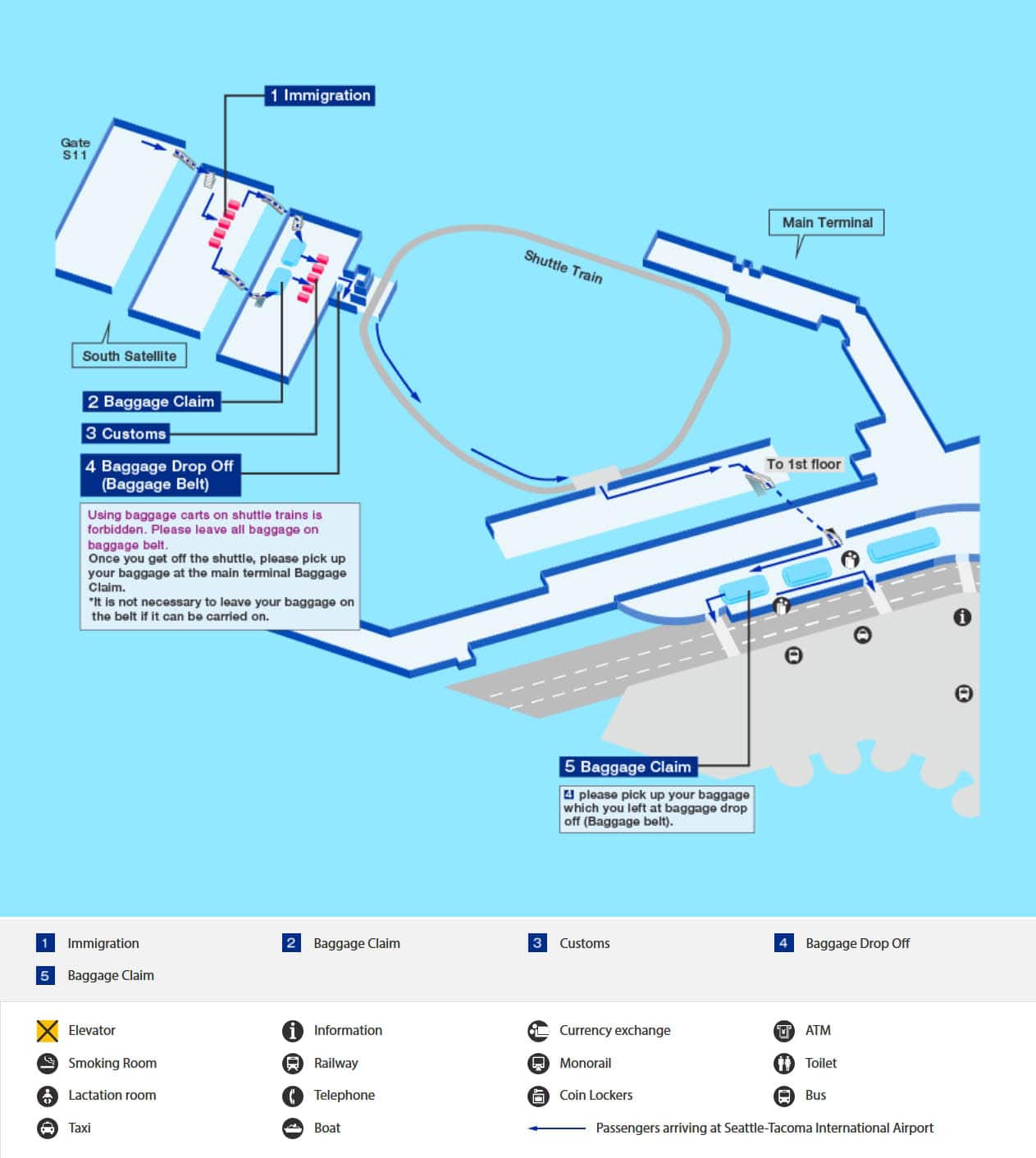
On Arrival
- All passengers should present your passport, Immigration card, and Customs Declaration Form upon arrival.
- See Special Guidance on this page for special Immigration rules for passengers entering the U.S. from abroad.
Customs
Carry-on luggage may be inspected.
Departure Terminal

Airport Map Information
Get details on the airport lounge.
Check-In
- Please present your passport and boarding pass.
- Since the boarding gate check-in counters might be subject to change; please check at the airport to the day of departure.
- See ANA International Airport Check-In Counter Opening Times.
Fast Track Security Screening
Some travelers are eligible for Fast Track Security Screening. Travelers should look for the Premium Lane.
Eligible Travelers
- Business class
- Diamond service members
- Platinum service members
- Super Flyers members
- Star Alliance Gold members
Transit
Transiting from ANA to Other Airlines
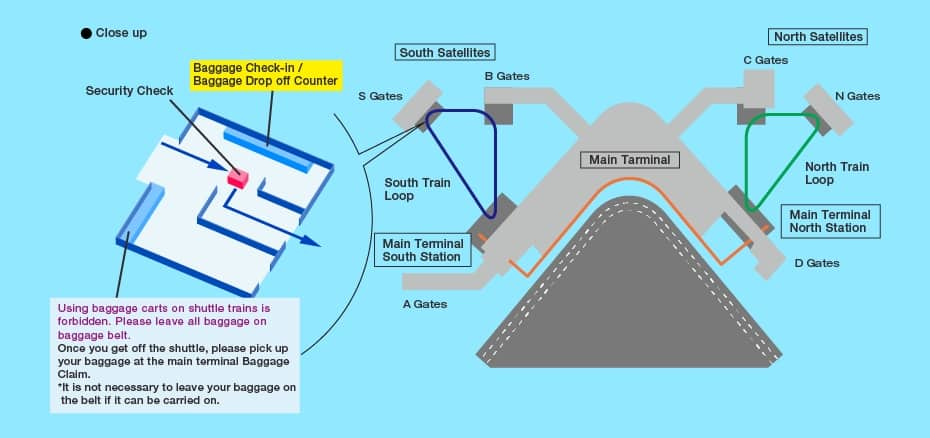
Checking Baggage
- All customers are required to pass through the Immigration control and custom inspection checkpoints—no matter the final destination.
- Your checked-in baggage must be picked up after completing Immigration control even when the final destination is printed on the tag of your baggage.
- Check-in locations vary.
Passengers who have not checked their baggage:
- Proceed to the boarding gate after security check at South Satellites.
- Passengers who have not checked in to the connecting flight can check-in at the boarding gate.
Passengers who have checked their baggage:
- Please check in the baggage again at the check-in counter at South Satellites.
- Please proceed to the boarding gate after Security Check.
Note: Passengers who have not checked in to the connecting flight can check in at the boarding gate.
If connecting by Delta Airline or Alaska Airlines who have not checked-in the baggage through to the final destination:
- Please check in the baggage at the check-in counter in South Satellites.
- Check-in services for those who have not yet finished are also available at the counter. Please proceed to the boarding gate after Security Check.
If connecting to flights that depart from S Gate:
Do not take the South Train Loop. Use the escalator to go up and proceed to the departing gate.
If connecting to flights that depart from A Gate:
Take South Train Loop and get off at Main Terminal South Station. Proceed up the escalator to the departure gate.
If connecting to flights that depart from B Gate:
Take South Train Loop and get off at B Gates. Proceed up the escalator to the departure gate.
If connecting to flights that depart from C/D/N Gates:
Take South Train Loop and get off at Main Terminal South Station. Then board the shuttle to Main Terminal North Station and get off at North Station.
If connecting to flights that depart from D Gate:
Go up the escalator and proceed to the departure gate.
If connecting to flights that depart from N/C Gates:
Transfer to North Train Loop, get off at N or C Gate, and take the escalator up to the departure gate.
If connecting to any other airlines and have not checked in baggage through to the final destination:
- Pick up your baggage and proceed to the counter of your airline in the main terminal.
- Then check-in your baggage at the airline's counter and proceed to the boarding gate. Boarding services are also available at the counter.
Seattle
On September 27th, 2019 (JST) current information.
Furthermore, the details under "Visa", "Passport" and "Note When you travel to the United States" are for Japanese nationals.
This information is likely to change suddenly, so please contact the relevant official authority (e.g., embassy) for the latest information.
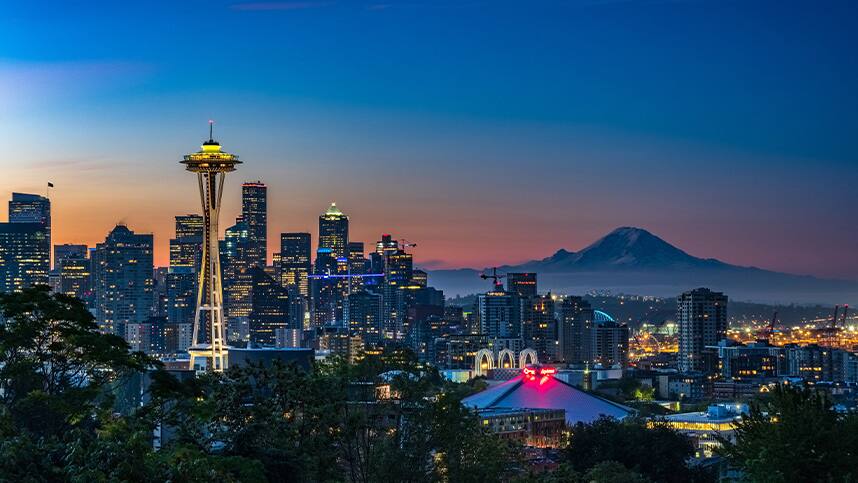
United States of America
Official Languages: English
Currency: United States dollar (USD)
Time Zone: UTC -8 (Pacific Standard Time)
Traveling to America?
Whether you’re connecting at the airport or will be exploring what this beautiful country has to offer, you’ll find all the helpful tips you need to know on this page—including the current exchange rate, climate information and more. For detailed country information, please visit the embassy’s website.
Immigration and Visa (For Japanese Nationals Only)
Visa
No visa is usually required for tourism or business trips within ninety days. However, entry to the US is often denied for those entering and exiting frequently, or those staying in the US for a long time. Those traveling with a visa waiver must obtain electronic travel authorization from ESTA (excluding entry by land).
Passport
It is preferable to have a passport that is valid for at least 90 days from the date of entry.
- * Note for travel to the United States
Note When you travel to the United States
ESTA
The Electronic System for Travel Authorization (ESTA) was introduced in 2009 for those wishing to travel to the United States without a visa. To use this system, you must apply for travel authorization in advance. Applications must be submitted at least 72 hours before departure on the official ESTA website(https://esta.cbp.dhs.gov/). Follow the procedure in Japanese, and enter the applicant information, passport information, travel information, address during your stay in the United States (e.g. your hotel), and other details in the roman alphabet. The application fee is $14. You can pay by American Express, MasterCard, VISA, or other credit card. Valid for two years from the completion of registration (except if your passport is lost).
Passport
Starting April 1, 2016, everyone traveling to the US without a visa must have an e-Passport (IC passport). This rule also applies to visitors with a valid Electronic System for Travel Authorization (ESTA). If you are traveling to the US with a visa waiver, you must confirm that your passport is an e-Passport (IC passport). Visa Waiver Program.
Revision of the visa waiver program
The Visa Waiver Program Improvement and Terrorist Travel Prevention Act was enacted on January 21, 2016. According to this act, the following individuals cannot travel to the US on the visa waiver program (VMP).
- Nationals of VWP countries who have traveled to or been present in Iran, Iraq, North Korea, Sudan, Syria, Libya, Somalia, or Yemen on or after March 1, 2011 (Libya, Somalia, and Yemen were added to the list on February 18, 2016. North Korea were added to the list on August 6, 2016).
- Nationals of VWP countries who are also nationals of Iran, Iraq, North Korea, Sudan, or Syria.
These individuals must apply for a visa. Travelers may be eligible for a visa waiver with case-by-case screening if the purpose of travel was official business for an international organization, news reporting by a journalist, or legitimate business activities. Please check with the US Embassy or Consulate for details. Please visit the U.S. Embassy and Consulates in Japan website to get more details about VISA.
- * Visa, passport, and other information is subject to change without notice. Be sure to check with the Embassy, Consulate, or travel agency.
Quarantine
When visiting from Japan, it is prohibited to bring the following items into the United States.
- a. Fruit, vegetables, plants, seeds, foods, insects, plant products
- b. Meat, processed meat, animals, animal or wild animal products (foods that contain eggs or meat extracts are also prohibited)
- c. Disease agents, cell cultures, snails
- d. Soil
- * Alcohol such as absinthe with the alcohol content of 70% or more cannot be brought in to the country.
- * Examples of food products that contain meat extract are cup noodles, furikake rice seasonings, curry roux, and instant soups.
Customs
Bringing in e-cigarettes
The scope for tax exemption is 200 cigarettes, same as for regular cigarettes.
If you want to enter in less than 18 years of age
The US Department of Homeland Security Customs and Border Protection (CBP) strongly recommends that those under 18 entering the US unaccompanied or accompanied by one parent or another individual who is not a parent or legal guardian have an English document signed by both parents or the parent who is not accompanying the minor.
For bringing and possession of tax-free cigarettes
For travelers who are 21 or older, tax is exempt for 1 L of alcohol for personal consumption or gifts up to $100 in value. Tax is exempt for up to 200 cigarettes (or 50 cigars or 2 kg for cut tobacco). All food products containing vegetables, fruit, meat, or meat extracts are not allowed to be brought into the country.
Time difference and Daylight Saving Time
Time difference
There are four time zones in mainland U.S. Japan is 17 hours ahead of Seattle. In summer, almost all states use Daylight Saving Time (summertime) and the clocks move forward an hour. The time difference between Japan and Seattle becomes an hour shorter. Daylight Saving Time is from the second Sunday in March to the first Sunday in November. When traveling, be careful of the changes in the time difference.
Climate
Climate
Spring starts in April. The leisure activity season fully starts in May. Summer is cool and winter is not as cold as you would expect on that longitude. The rainy season is from fall to winter with nonstop rain. The tourist season is from June to October. Summer is very hot and sunny, so a hat, sunglasses, and sunscreen are essential.


Currency and Exchange Rate, Tax, Currency exchange, Tip
Currency and Exchange Rate
The unit of currency is dollars ($) and cents (¢). $1 is JPY105.98 (as of September 4, 2019). There are six denominations of banknotes: $1, $5, $10, $20, $50, and $100. Note that many smaller shops do not accept $50 or $100 bills. There are six types of coins: 1¢, 5¢, 10¢, 25¢, 50¢, and 100¢ (100¢ is $1), but the 50¢, and 100¢ coins are not widely distributed.

US banknotes and coins
Tax
There is a sales tax applied when making purchases and a hotel tax applied when staying at hotels. The rate (%) varies with the state or city. When eating at a restaurant, you will also be charged tax that is equal to or higher than the sales tax. There is no sales tax in certain places like Portland, Oregon and Montana, and states like Lousiana and Texas have a tax refund system for overseas travelers.
Tip
It is customary to tip when receiving any type of service, for example at restaurants, in taxis, or when staying at hotels (e.g. to the bellhop or housekeeping staff). The amount differs depending on whether a special request was made or the level of satisfaction with the service, but the following values serve as references.
- Restaurants: 15 to 20% of the total. If a service charge is included with the meal, leave some change on the table or tray when leaving.
- Taxis: Tips are about 15% to 20% of the fare (at least 1 USD).
- Hotels: Depending on the size and number of pieces of luggage, bellhops should be tipped about $2 to 3 per piece. Tip well if you have a lot of luggage. Leave $1 to 2 on the pillow for housekeeping staff.
Voltage and plug
Voltage
The voltage is 120 V. Plugs are three-pin. Although Japanese products with 100 V, two-pin plugs can be used as is, it should be noted that there is a minor voltage difference. Extended use of appliances such as hair dryers or chargers may result in overheating, so special measures should be taken, such as breaking up usage into shorter durations of time.

Video and DVD
Video and DVD
The TV and video system is NTSC in both Japan and the US, and the Blu Ray region code is A in both Japan and the US, so media from both countries can be played on media players in the other country. However, the DVD region code is 1 for the US and 2 for Japan. Therefore media that does not include both region codes or the label 'All codes' is not cross-compatible.
Postal fees
Airmail to Japan is $1.15 for letters and postcards. There are some postal methods with a set rate for using a specified envelope or box.
Post office hours
Hours vary slightly between towns/cities. Post offices are generally open from around 9:00 to 17:00 on weekdays.Postal boxes are blue. Mail designated as EXPRESS MAIL is only express for domestic deliveries.
Phone Call
Telephoning Japan from the United States of America
Ex. When calling (03) 1234-5678:
- dial 011 (International telephone identification numbers)
- 81 (Country Code, Japan)
- 3 (Remove the first 0 for area codes)
- 1234-5678 (Other parties telephone No.)
Telephoning the United States of America from Japan
Ex. When calling Los Angeles (213) 123-456:
- International Telephone Company No.
- 001 (KDDI)*1
- 0033 (NTT Communications) *1
- 0061 (SoftBank Telecom) *1
- 005345 (au Mobile) *2
- 009130 (NTT DoCoMo Mobile) *3
- 0046 (SoftBank Mobile)*4
- 010 (International Identification No.)
- 1 (Country Code, The United States of America)
- 213 (Area Code)
- 123-4567 (Other parties telephone No.)
-
*1.Not required if you have an international registration with "My Line" or "My Line Plus". See URL My Line/My Line Plus(www.myline.org) for details.
-
*2.au does not require 005345.
-
*3.Pre-registration to World Wing is required for NTT DoCoMo. Does not require 009130.
-
*4.Call are possible without dialing 0046 from SoftBank.
- * For the three cell phone carriers, hold down 0 until + appears, then add the country code and the phone number your wish to dial.
Holiday / National holiday
Holiday / National holiday
Note that some states have different holidays. Shops that claim to be open year-round are almost always closed on New Year's Day, Thanksgiving Day, and Christmas Day. Also, many stores have different hours during the summer holidays from Memorial Day to Labor Day.
- January 1: New Year's Day
- 3rd Monday of January: Birthday of Martin Luther King Jr.
- 3rd Monday of February: Presidents' Day
- March 17: St. Patrick's Day*1
- March 31: Cesar Chavez Day
- 3rd Monday of April: Patriots' Day*1
- Last Monday of May: Memorial Day
- July 4: Independence Day
- 1st Monday in September: Labor Day
- 2nd Monday in October: Columbus Day*1
- November 11: Veterans Day
- 4th Thursday in November: Thanksgiving Day
- December 25: Christmas Day
-
*1.Some states have different holidays.
Language
Language
Mostly English, although it is not the law. Spanish is used in many places across the US.
Business hours, etc
Business hours
Below are guidelines for general business hours. Hours vary with the type of business and location. Supermarkets are open either 24-hours a day or 22-hours. It is not rare for stores to close at around 19:00 in urban business districts.
Banks
Mon. to Fri. 9:00 to 17:00.
Department Stores/Shops
Mon. to Fri. 10:00 to 20:00, Sat. 10:00 to 19:00, Sun. 11:00 to 18:00.
Restaurants
Coffee shops and other cafes are open from the morning. Breakfast is from 7:00 to 10:00, lunch from 11:30 to 14:30, and dinner from 17:30 to 22:00. Bars are open until late at night.
Age Limit
Although it varies by state, the drinking age is generally 21. Some places require you to show ID when buying alcohol. ID is also required at clubs and other places that serve alcohol. In the US, there is a very high rate of car accidents among younger drivers, and, with very few exceptions, almost all major car rental companies do not rent cars to people under 25. Extra fees are often required for drivers between the age of 21 and 24.
Copyright (C) Globe-Trotter Media Partners Inc. All Rights Reserved.
Copyright (C) Diamond-Big Co., Ltd. All Rights Reserved.
Before Traveling to the USA
Passengers traveling to the United States from abroad must provide passport information and the documents listed here that are required for entering the United States.
Electronic System for Travel Authorization (ESTA):
Passengers are required to obtain pre-travel authorization through the Electronic System for Travel Authorization (ESTA) to enter the USA under the Visa Waiver Program (see below).
- There is a $14 charge.
- ESTA must be completed before commencing boarding procedures for a USA-bound flight. Customers cannot board without travel authorization.
- U.S. authorities strongly advise travelers who wish to travel to the USA to apply at least 72 hours before their travel date.
- An ESTA application is required even when traveling to a third country via the USA.
Secure Flight Program:
The Secure Flight Program requires passengers to provide their passport name, date of birth and gender at least 72 hours prior to departure or at the time of booking if the reservation is made inside the 72-hour window.
Visa Waiver Program
The U.S. Visa Waiver Program (VWP) enables most nationals of participating countries to travel to the United States for tourism or business for 90 days or less without obtaining a visa.
Travelers must have a valid ESTA approval prior to travel and must meet all requirements for the program.
- If you prefer to have a visa in your passport, you may still apply for a visitor (B) visa.
VWP Participating Countries
- Andorra
- Australia
- Austria
- Belgium
- Brunei
- Chile
- Czech Republic
- Denmark
- Estonia
- Finland
- France
- Germany
- Greece
- Hungary
- Iceland
- Ireland
- Italy
- Japan
- Latvia
- Liechtenstein
- Lithuania
- Luxembourg
- Malta
- Monaco
- Netherlands
- New Zealand
- Norway
- Poland
- Portugal
- San Marino
- Singapore
- Slovakia
- Slovenia
- South Korea
- Spain
- Sweden
- Switzerland
- Taiwan*
- United Kingdom*
Recent VWP Changes
Recent changes to the Visa Waiver Program prohibit the following customers from travelling under VWP; such passengers must apply for a non-immigrant visa.
- Nationals of VWP countries who have traveled to or been present in Iran, Iraq, Sudan, Syria, Libya, Somalia, or Yemen on and after March 1, 2011.
- Nationals of VWP countries who are also nationals of Iran, Iraq, Sudan, or Syria.
A waiver may be obtained on a case-by-case basis for those who have traveled to the areas mentioned above for official duties of an international organization, regional organizations or sub-national government; journalists for reporting purposes; and legitimate business-related purposes in Iran and Iraq. Please contact your nearest U.S. embassy or consulate for waiver information.
Required Passenger Information
The U.S. Transportation Security Administration requires that all passengers provide the following information at least 72 hours before departure to the United States.
- Full Name (the first and last name registered on your passport)
- Date of Birth (according to the Western calendar)
- Gender
- Redress Number if you have one.
- The U.S. Department of Homeland Security (DHS) grants Redress Numbers as a means of protecting passengers who may be incorrectly identified as being on a watch list due to various reasons, such as sharing a first and last name with a suspected terrorist.
- Passengers will have to apply to the TRIP (Traveler Redress Inquiry Program) to obtain a Redress Number.
- Known Traveler Number if you have one.
- A Known Traveler Number is a PASS ID provided to members of trusted traveler programs, such the Global Entry Program. Those in possession of this ID are eligible for TSA Pre✔®, the TSA's expedited screening program.
- Passengers who are eligible for this program are able to experience quicker process of U.S. airport security screening by passing through a dedicated lane and are not required to remove shoes, belts, light jackets, laptops and liquids. Children 12 and under accompanied by an eligible passenger may go through the dedicated lane as well. Learn more about TSA Pre✔®.
Enhanced Security of Electronic Devices
The U.S. has recently enhanced its security measures to include security checks of some electronic devices on flights bound to the US. Some electronic devices must undergo security check at the boarding gate based on TSA regulations.