


Traveling to and from Paris
On this page, you will find the information you need to easily make your way through Charles de Gaulle Airport to your destination.
Guide to France’s Charles de Gaulle Airport
Arrival and departure terminal maps and other information for navigating Charles de Gaulle Airport.

Arrival Terminal
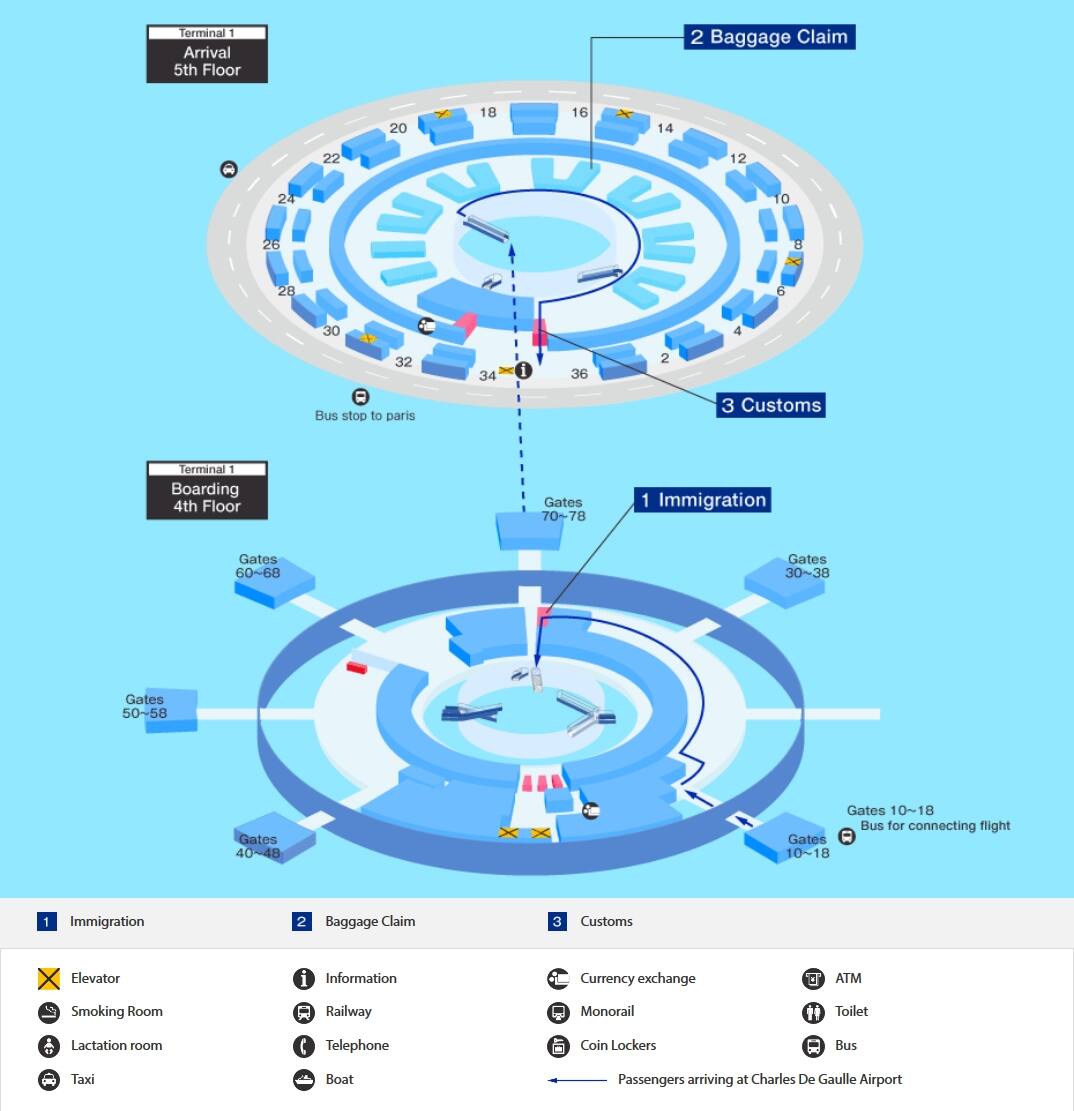
Immigration
Please present your passport. See Special Guidance info on this page for details if traveling to and/or between Schengen countries.
Customs
There may be a carry-on luggage inspection. Passengers who wish to bring cash of EUR 10,000 or more must declare.
Departure Terminal

Check-In
- Please present your passport and boarding pass.
- Boarding gate check-in counters are subject to change; please check at the airport.
- See ANA International Airport Check-In Counter Opening Times.
Immigration
Please present your passport and boarding pass.
Priority Lane for Immigration and Security Control
The priority lane for Immigration/security control (Access No. 1) is available to the following customers:
- Business Class
- Diamond Service Members
- Platinum service Members
- Super Flyers Members
- Star Alliance Gold Members
Look for the "Access No.1" sign and scan your boarding pass or a voucher when using this service.
VAT refunds
A value-added tax refund (VAT) is applicable for residents outside of the European Union who are over 15 years of age. It only concerns non-commercial tourist purchases for amounts in excess of €175.01 in the same shop on the same day in France.
For duty free display shops, department stores or prestige shops:
- Once you meet the VAT threshold, please inform a shop assistant that you wish to receive an export sales slip with your purchase.
- Upon departure, show the purchased item, your passport and an export sales slip to DETAXE counter on the 2nd floor before check-in. After getting your check stamped, you need to send your export sales slips at the post box near Customs.
Note: Please see Customs information of each country for the latest information.
Transit
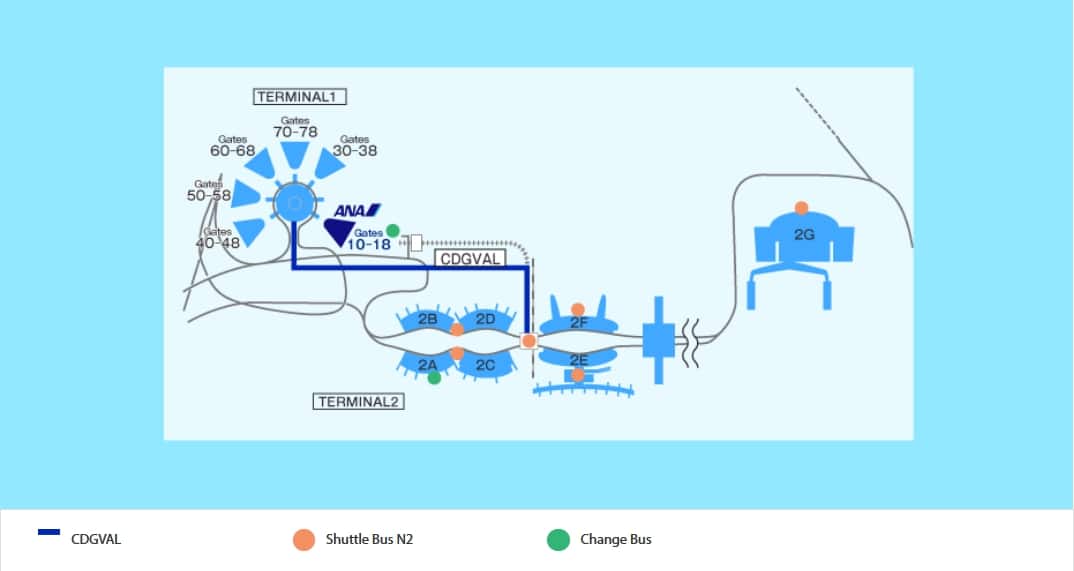
Airport Access
CDGVAL is an automated vehicle similar to monorail. It is available between Terminals 1, 2 and 3. The change bus is available between Terminal 1 and Terminal 2A. The connecting bus operates every 20 minutes.
Connecting from ANA to Other Airlines
Connecting to flights departing from Terminal 1:
- If connecting to a flight leaving for a Schengen country and checked in to the final destination, please proceed to Gates 60-68 or Gates 70-78 directly after Immigration.
- If connecting to a flight leaving for a non-Schengen country, please proceed directly to the boarding gate.
Connecting to flights departing from Terminal 2 (A, B, C):
From Gates 20-28, please get to 2A by taking the shuttle bus within the restricted area bound for Terminal 2. After getting off at 2A, proceed to 2B or 2C on foot.
Connecting to flights departing from Terminal 2 (D, E, F):
After Immigration, please proceed to Terminal 2 using CDGVAL that departs from Boutiques/Restaurants floor—then proceed to 2D, 2E and 2F on foot.
Connecting to flights departing from Terminal 2G:
After Immigration, please proceed to Terminal 2 using CDGVAL that departs from Boutiques/Restaurants floor—then go upstairs to the bus stop of N2 and proceed to 2G by N2 bus.
Connecting from Other Airlines to ANA
Passengers arriving from a Schengen country and checked-in luggage to Tokyo should proceed to Gates 10-18 after clearing Immigration. Note: There is no need to go through the baggage claim area on the 3rd floor after clearing Immigration. Please claim your luggage at the final destination airport (Tokyo).
Paris
On July 19th, 2019 (JST) current information.
Furthermore, the details under "Visa" and "Passport" are for Japanese nationals.
This information is likely to change suddenly, so please contact the relevant official authority (e.g., embassy) for the latest information.
French Republic
Official Language: French
Currency: Euro (EUR)
Time Zone: UTC +1 (CET)
Travelling to France?
Whether you’re connecting at the airport or will be exploring what this beautiful country has to offer, you’ll find all the helpful tips you need to know on this page—including the current exchange rate, climate information and more. For detailed country information, please visit the embassy’s website.
Immigration and Visa (For Japanese Nationals Only)
Visa
Not required for tourism (stays of up to three months).
Passport
Your passport must be valid for at least three months from the date of departure from France or another country in the Schengen Area.
- * Schengen Agreement
As of October 2018, countries in the Schengen Area are Iceland, Italy, Estonia, Austria, Holland, Greece, Switzerland, Sweden, Spain, Slovakia, Slovenia, the Czech Republic, Denmark, Germany, Norway, Hungary, Finland, France, Belgium, Poland, Portugal, Malta, Latvia, Lithuania, Lichtenstein, and Luxembourg. When entering from Japan or another country outside of the Schengen Area, complete Immigration and Customs clearance upon arriving at the first country in the area during your visit.
- Visa, passport, and other information is subject to change without notice. Be sure to check with the Embassy, Consulate, or travel agency.
Quarantine
When visiting from Japan, it is prohibited to bring the following items into France.
- a. Fruit, vegetables, plants, seeds, insects
- b. Meat, dairy products, some animals
- c. Disease agents, cell cultures, snails, coral
- d. Pharmaceutical products other than for personal use (up to 3 months' worth)
- * Violations may result in fines or imprisonment.
Customs
Bringing in e-cigarettes
If you are bringing it in for your personal use, when flying from Japan to France.
For bringing and possession of tax-free cigarettes
- Tobacco: 17 years old and older. 200 cigarettes, 50 cigars, 100 small cigars, or 250g of cut tobacco
- Liquor: 17 years old and older. 4L of wine, 16L of beer, or 1L of an alcoholic beverage containing over 22% alcohol (22% or below is 2L)
- Other: If you carry €10000 or more in cash, foreign currency, or negotiable instruments into or out of the country, you must report it.
Time difference and Daylight Saving Time
Time difference
France is in the Central European Time zone (CET). There is an 8-hour time difference between Japan and France. Subtract 8 from the hour in Japan to calculate the hour in France. In other words, 18:00 in Japan is 10:00 on the same day in France. This changes to a 7-hour difference during daylight saving time,
which begins at 2:00 at night on the last Sunday of March and ends at 3:00 at night on the last Sunday of October. Daylight saving time in 2019 is from March 31 to October 27, and from March 39 to October 25 in 2020.
- * Note: Abolition of Daylight Saving Time is currently under consideration.
Climate
Climate
The climate in Paris can be thought of as basically identical to the four seasons in Tokyo. The advent of spring can be felt around April. As there is no rainy season, the weather is dry, so summer is brisk and comfortable. While some days in July and August see daytime temperatures of around 30℃, dusk and dawn may be chilly. Autumn comes earlier than in Tokyo and there is a relatively high amount of rainfall. In November, winter is already underway and there tends to be more cloudy days. Weather conditions can vary from year to year even in the same season. Please check the weather forecast before departure.

Temperatures in Paris and Tokyo

Precipitation in Paris and Tokyo
Currency and Exchange Rate, Tax, Currency exchange, Tip
Currency and Exchange Rate
The unit of currency is the Euro (written as €, EURO, or EUR), which is divided into cents. They are read in French as Euro and centime. €1 is 100 cent, approx. JPY122 (as of July 2019).
There are seven denominations of banknotes: €500, €200, €100, €50, €20, €10, and €5. There are eight types of coins: €2, €1, 50 cent, 20 cent, 10 cent, 5 cent, 2 cent, and 1 cent.

Note: Starting in 2013, new designs for banknotes are being introduced, beginning with small denominations.
Tax
In France, a 12% to 18.6% tax exemption (differs by shop) is applied to purchases of at least €175.01 made in a single day at a single shop by a foreign traveler. This applies to products taken out of the EU without being used. Visitors must show their passport at the shop of purchase, have a tax exemption form drawn up, and get a tax refund at the airport.
Tip
Fees charged in places such as restaurants and hotels include a service charge, so basically there is no obligation to tip. It may be a good idea to leave a tip as a thank you when receiving good service or when asking for a special favor.
- Restaurants: A rule of thumb is 5% to 10% of the meal charge when eating at an upscale restaurant. It is good to leave a tip as a thank you that is a nice rounded number. At casual restaurants, leave the change from the bill.
- Hotels: When asking for a special favor, tip approx. €2 to 5 each time. It is not necessary to tip for normal cleaning or bed-making services.
- Taxis: If you have large luggage carried to the trunk for you, tip about €2 to 5.
- Ushers at Playhouses, etc.: Tip approx. €1 as a thank you for being seated.
Voltage and plug
Voltage
The standard voltage is 220V with a cycle of 50Hz. Electric products made for use in Japan cannot be used as is. A transformer is necessary. The type of plug used is C type.
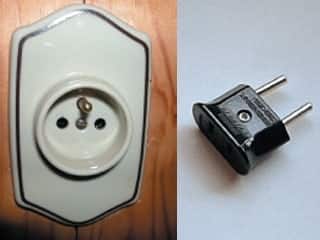
Outlet / Cell phone plug
Video and DVD
Video and DVD
The output system is PAL/SECAM in France, but NTSC in Japan. Since they are different, a DVD purchased in France cannot be viewed on ordinary DVD players in Japan (they can be played on computers equipped with a DVD drive or a computer that can be directly connected to a DVD drive).
Blue Ray discs can be played on a Japanese DVD player if it is compatible with the region code A used in Japan.
Post offices in France are called La Poste. Stamps can be purchases at post offices and at TABAC (tobacco shops).
Postal Fees
Both a postcard and sealed letter up to 20g cost €1.3. Postcards of various sizes and shapes are sold, but since they are the same price up to 20g, they can be sent for €1.3.
Phone Call
Telephoning Japan from France
- Dial 00 (International telephone ID Number)
- 81 (Country Code, Japan )
- Remove the first 0 for area codes and mobile telephone numbers
- Other parties telephone No.
Telephoning France from Japan
- International Telephone Provider No.
- 001 (KDDI)*1
- 0033 (NTT Communications) *1
- 0061 (SoftBank Telecom) *1
- 005345 (au Mobile) *2
- 009130 (NTT DoCoMo Mobile) *3
- 0046 (SoftBank Mobile)*4
- 010 (International Identification No.)
- 33 (Country Code, France)
- Other parties telephone No. (Remove the first 0 for area codes and mobile telephone numbers)
-
*1.Not required if you have an international registration with "My Line" or "My Line Plus". See URL My Line/My Line Plus(www.myline.org) for details.
-
*2.au does not require 005345.
-
*3.Pre-registration to World Wing is required for NTT DoCoMo. Does not require 009130.
-
*4.Call are possible without dialing 0046 from SoftBank.
Holiday / National holiday
Holiday / National holiday
There are many national holidays related to Christianity. Note that some national holidays fall on different days, depending on the year.
2020
- January 1: New Year's Day
- April 12: Easter Sunday *1
- April 13: Easter Monday*1
- May 1: May Day
- May 8: V-E Day
- May 21: Ascension Day*1
- May 31: Whit Sunday*1
- June 1: Whit Monday*1
- July 14: Bastille Day
- August 15: Assumption Day
- November 1: All Saints' Day
- November 11: Armistice Day
- December 25: Christmas Day
-
*1.National holidays fall on different days, depending on the year.
Language
Language
French
Business hours, etc
Business hours
Below are guidelines for general business hours, which differ by shop and restaurant, and are extremely changeable. Note that many establishments are closed for long periods during the summer vacation season, etc.
Banks
Mon. to Fri. 9:00 to 17:00, closed on Sat., Sun., holidays. Differs by bank.
Post Office
Mon. to Fri. 8:00 to 20:00, Sat. 9:00 to 13:00, closed on Sun., holidays (may differ according to post office).
Department Stores
Mon. to Sat. 9:30 to 20:00, closed on Sun. and are closed on some holidays.
Shops
Mon. to Sat. around 10:00 to 19:00. Some shops are closed for lunch. Many shops close on Sun. and holidays.
Cafés
around 8:00 to 24:00.
Restaurants
12:00 noon to 14:00, around 19:30 to 23:00 at night, some restaurants are closed on Sun. and holidays.
Age Limit
The minimum drinking age in France is 16. There is no law prescribing the minimum age for smoking. Both Hertz and Avis require persons to be 21 or older to rent a car (some exceptions exist, depending on vehicle type).
Smoking
Smoking in Public Areas
In France, smoking is completely prohibited in all enclosed public spaces. Hotels, cafes, and restaurants are permitted to arrange special exceptional smoking areas. Also, smoking may be permitted in outdoor seating areas at establishments where food and beverages are served. Violators will be fined €68.
Copyright (C) Globe-Trotter Media Partners Inc. All Rights Reserved.
Copyright (C) Diamond-Big Co., Ltd. All Rights Reserved.
Traveling Between Schengen Countries
The establishment of the EU and the Schengen Agreement has simplified entry and departure procedures within Europe. Once a Japanese national has arrived at one of the Schengen countries, travel within that country is treated as “internal domestic” travel. The following entry and departure procedures apply to passengers traveling from one Schengen country to another Schengen country.
- Entry:
- Taken only in the first country of arrival.
- Customs inspection for carry-on baggage is made at the first country of arrival and at the final destination for checked-in baggage.
- Departure:
- Taken only in the last Schengen country to be departed from.
- The Customs inspection is made at the destination country.