


Traveling to and from the Philippines
On this page, you will find the information you need to easily make your way through Manila Ninoy Aquino International Airport to your destination.
Guide to the Philippines’ Manila Ninoy Aquino International Airport
Arrival and departure terminal maps and other information for navigating through Manila Ninoy Aquino International Airport.

Arrival Terminal
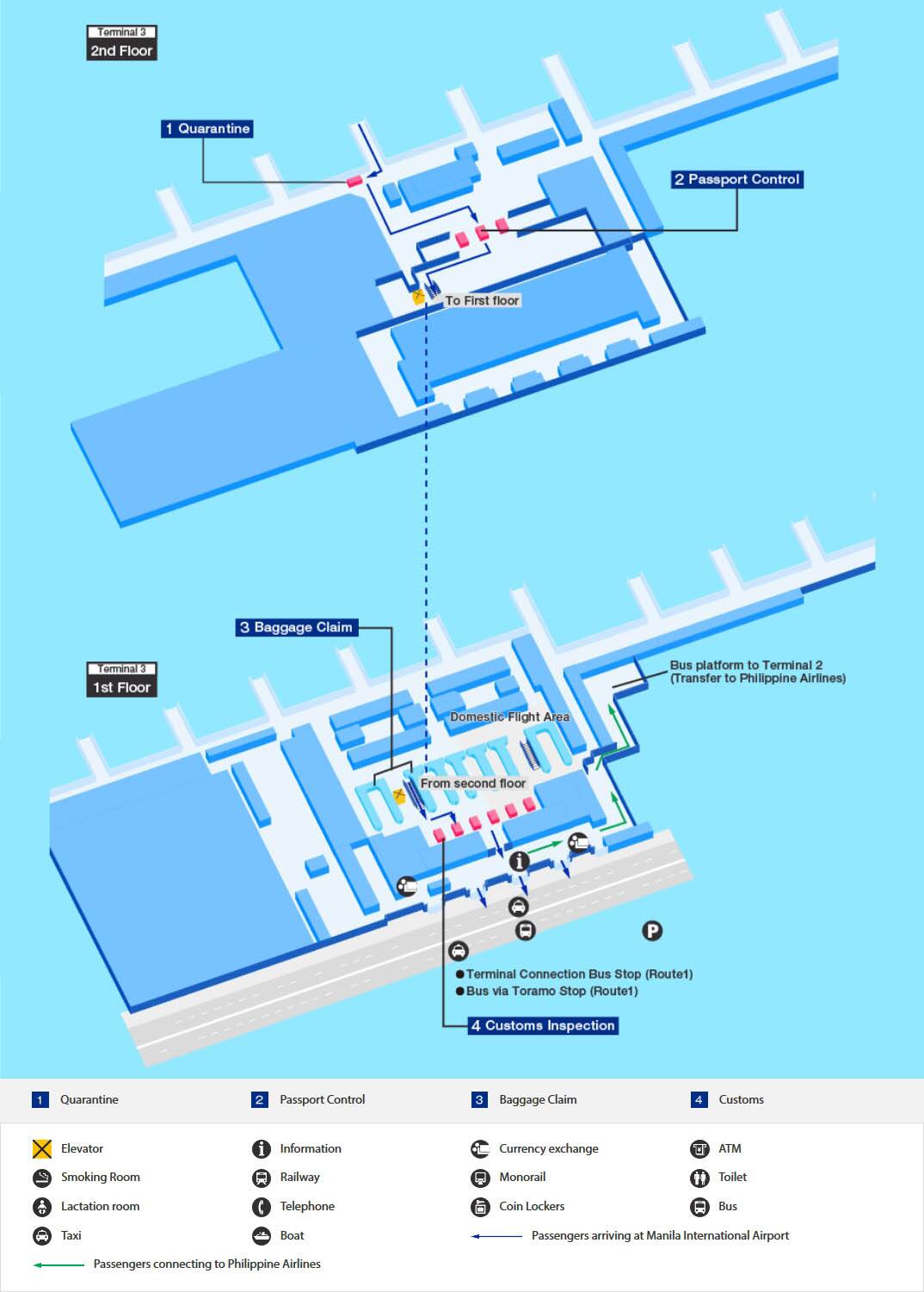
Airport Map Information
Flights operated by ANA Group will arrive at Terminal 3.
Immigration
- Please present your passport and Immigration card.
- You will need to show a return flight ticket or ticket for a flight bound for a third country when passing through Immigration.
- Note: Passengers without a paper ticket or a printed Itinerary Receipt will be denied entry. Photos on a computer or phone are not accepted.
Passengers with Connecting Flight
After clearing all the arrival procedures, proceed to the check-in counter or airport terminal of your next flight.
Departure Terminal

Flights operated by ANA will depart from Terminal 3. Learn more about the Airport Lounge.
Check-In
- Please present your passport and boarding pass.
- Since the boarding gate check-in counters might be subject to change; please check at the airport to the day of departure.
- See ANA International Airport Check-In Counter Opening Times.
Security Check
After Security Check, please go to the boarding gate.
Transit
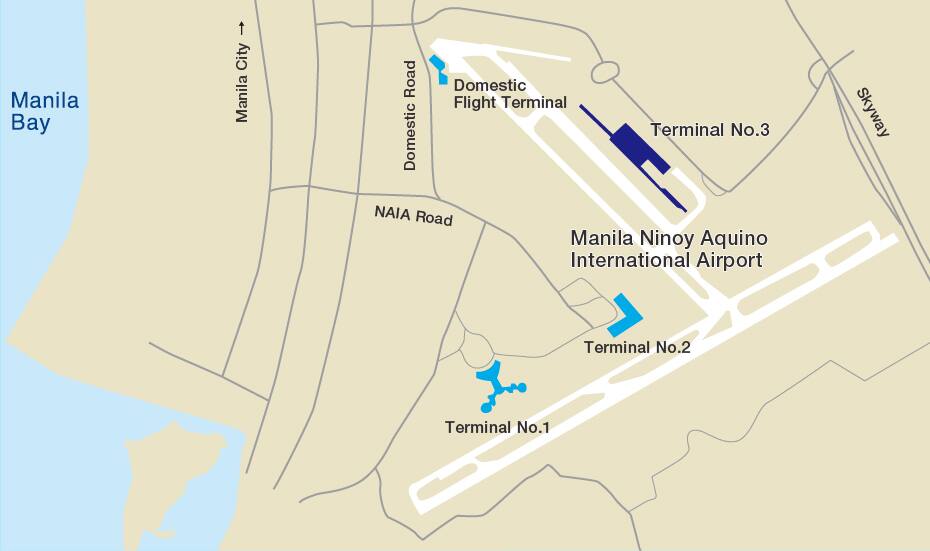
Traveling Between Terminals
- If you need to transit between terminals, taxis and a free shuttle bus are available. The waiting time may vary based on operation status and traffic congestion.
- You will need to go through Security Check to enter the departure terminal for connecting flights and Immigration/Customs can get busy.
- Passengers who have connections should allow ample time for these processes.
Note: Passengers who use connecting Philippine Airlines flights departing from Terminal 2 or connecting flights of ANA from Philippine Airlines flights arriving at Terminal 2 are requested to use the shuttle bus operated between terminals by Philippine Airlines.
Manila
On September 27th, 2019 (JST) current information.
Furthermore, the details under "Visa", "Passport" and "Vaccination" are for Japanese nationals.
This information is likely to change suddenly, so please contact the relevant official authority (e.g., embassy) for the latest information.
Philippines
Official Languages: Filipino, English
Currency: Peso (PHP)
Time Zone: UTC +8 (Philippine Standard Time)
Traveling to Philippines?
Whether you’re connecting at the airport or will be exploring what this beautiful country has to offer, you’ll find all the helpful tips you need to know on this page—including the current exchange rate, climate information and more. For detailed country information, please visit the embassy’s website.
Immigration and Visa (For Japanese Nationals Only)
Visa
Not required for stays of up to thirty days. To stay longer than thirty days, you can get a tourist visa from the Philippine Embassy or Consulate General in Japan that is valid for 59 days. You can also complete a stay extension procedure in the country to extend your stay initially by 29 days.
Passport
Your passport must be valid until your date of departure from the Philippines.
Quarantine
There is no list of specified items that cannot be brought into the Philippines from Japan. However, an import declaration is required for bringing in any animals, plants, fish, or processed items made with those items.
Customs
Bringing in e-cigarettes
As of November 2019, there are no regulations for bringing it in the country.
Vaccination
Not required when departing from Japan.
For bringing and possession of tax-free cigarettes
Visitors may bring up to 2 regular-sized bottles of liquor (1L), 400 cigarettes, 50 cigars, and 250g of pipe tobacco tax free. Up to P50000 can be brought in or taken out. Foreign currency is over US$10000 must be declared. In addition, bringing in and taking out firearms, drugs, obscene materials, and counterfeit brand-name goods is prohibited.
Time difference and Daylight Saving Time
Time difference
The Philippines is 1 hour behind Japan. When it is 12:00 in Japan, it is 11:00 in the Philippines. Daylight saving time is not observed in the Philippines.
Climate
Climate
The Philippines has a tropical climate that is warm throughout the year with an average yearly temperature of 26°C to 27°C. The seasons are divided into the rainy season from June to November, and the dry season from December to May, but there is a significant difference depending on region. Clothing worn in summer in Japan is suitable for wearing in the Philippines throughout the year. However, some places have the air conditioning turned up in airplanes, overnight buses, hotels, department stores, etc., so it is best to have a jacket to cover up with. The sunlight is strong, so bringing sunglasses and a hat is convenient.
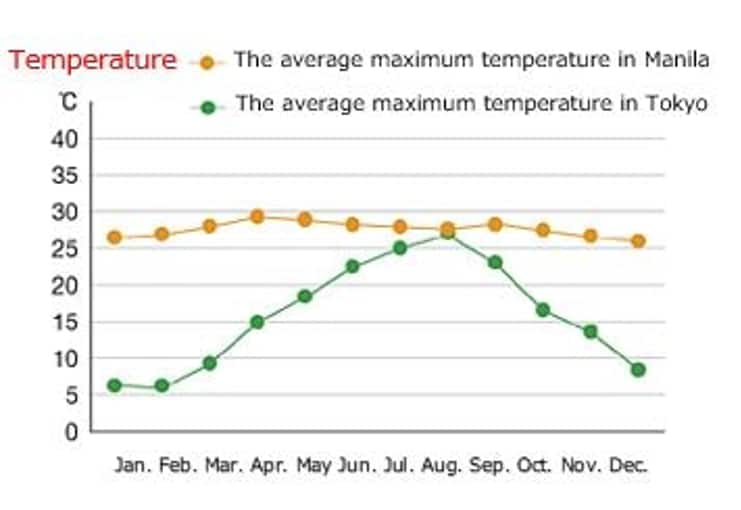
The average temperature in Manila and Tokyo
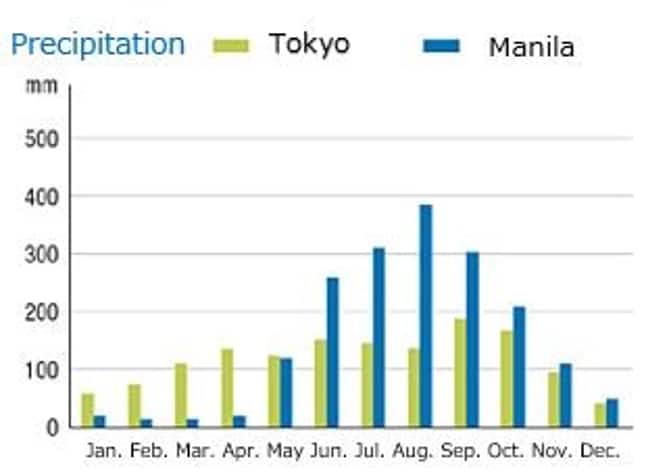
Precipitation in Manila and Tokyo
Currency and Exchange Rate, Tax, Currency exchange, Tip
Currency and Exchange Rate
The unit of currency is the Philippine peso (P), which is subdivided into centavos (¢). P1 is 100¢. As of September 3 2019, US$1 is approx. P52.29, P1 is approx. JPY2.03.
There are eight denominations of banknotes: P1000, P500, P200, P100, P50, P20, P10, and P5 (P200, P10, and P5 are not often seen). There are eight types of coins: P10, P5, P1, 50¢, 25¢, 10¢, 5¢, and 1¢ (the 50¢, 10¢, 5¢, and 1¢ are not often seen).

New coins are in circulation as of the end of 2017. The validity end date of the old coins has not been decided, and so they are currently still in use.
Currency Exchange
US dollars and Japanese yen can be changed into Philippine peso at hotels, city banks, moneychangers, and banks in airports. Moneychangers offer the best exchange rates, and hotels the worst. Often, banks will not accept Japanese yen in exchange. Keep the receipt for currency exchange until the last day of your trip as sometimes it must be shown when re-changing money. In addition, often change is not available in Japanese yen at banks and moneychangers, so bringing plenty of 1000-yen bills from Japan cuts down on excessive currency exchange. Furthermore, when traveling to rural areas, it is safer to exchange Japanese yen for pesos in Manila, Cebu, etc.
Tip
Porters at the airport and hotels should be tipped P10 to P20 per piece of luggage, and when restaurant bills do not include a service charge or taxi, usually a tip of approx. 10% of the meal charge is left.
Voltage and plug
Voltage
220V, 60Hz. The shape of the plug is mostly the same as that in Japan (type A), but type B3, C, or O is used in some parts of the country. A transformer is needed for using electrical devices that are not compatible with 100 to 240V.
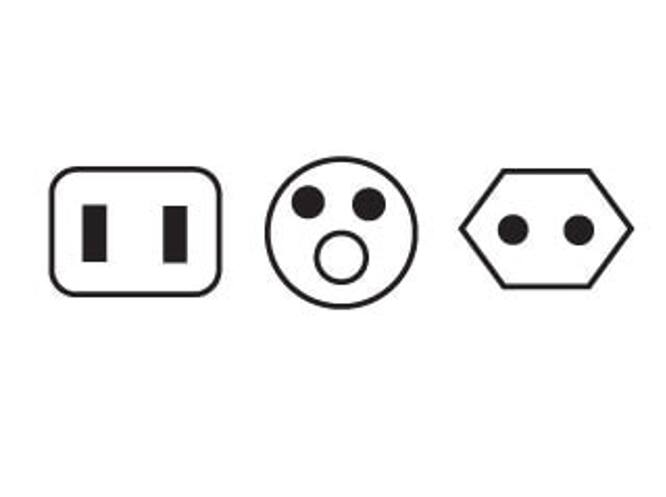
Type A, Type B3, Type C
Video and DVD
Video and DVD
The Philippines uses the same NTSC video system as Japan, so normal video players used in Japan can play DVD and other media from the Philippines. The DVD region code for the Philippines is 3, while it is 2 for Japan. However, if a DVD displays region code 2, it can be played on a computer equipped with a DVD player.
Airmail to Japan costs P45 for a sealed letter up to 20g and P15 for a postcard. Mail is delivered to Japan in 5 to 10 days.
Phone Call
Telephoning Japan from Philippines
When calling Tokyo (03) 1234-5678:
- dial 00 (International telephone identification number)
- 81 (Country Code, Japan)
- 3 (Remove the first 0 for area codes and mobile telephone numbers)
- 1234-5678(Other parties telephone number)
Telephoning Philippines from Japan
When calling Philippine Manila (02) 2345-6789
- International Telephone Company No.
- 001 (KDDI)*1
- 0033 (NTT Communications) *1
- 0061 (SoftBank Telecom) *1
- 005345 (au Mobile) *2
- 009130 (NTT DoCoMo Mobile) *3
- 0046 (SoftBank Mobile)*4
- 010 (International Identification No.)
- 63 (Country Code, Philippines)
- 2 (Remove the first 0 for area codes)
- 2345-56789 (Other parties telephone number)
-
*1.Not required if you have an international registration with "My Line". See URL My Line(www.myline.org) for details.
-
*2.au does not require 005345.
-
*3.Pre-registration to World Wing is required for NTT DoCoMo. Does not require 009130.
-
*4.Call are possible without dialing 0046 from SoftBank.
- * For the three cell phone carriers, hold down 0 until + appears, then add the country code and the phone number your wish to dial.
Holiday / National holiday
Holiday / National holiday
There are many holidays related to Christianity. Note that holidays fall on different dates, depending on the year. On national holidays, shops, banks, post offices, etc. are closed. There are also special holidays.
- January 1: New Year’s Day
- Late January to Mid February: Chinese New Year*1
- February 25: EDSA People Power Revolution
- Late March to Mid April: Easter holiday*1
- April 9: Day of Brave
- May 1: May Day
- June 12: Independence Day
- August 21: Ninoy Aquino Day
- Last Monday in August: National Heroes Day*1
- November 1: All Saints Day
- November 30: Bonifacio Day
- December 8: Immaculate Conception
- December 25: Christmas
- December 30: Rizal Day
- December 31: New Year's Eve
-
*1.holidays fall on different dates, depending on the year.
Language
Language
The official language is Filipino (Tagalog). However, depending on the region, Filipino other than Tagalog is used, such as Visayan in the Visayan Islands. In parts of the Cavite province outside of Manila and parts of the Mindanao Island, the Chavacano language is also spoken, which includes a lot of Spanish. English is the common language and is the most understood language in Asia. There are around 80 other languages in the Philippines, including Llocano and Waray.
Business hours, etc
Business hours
Banks
Generally open from Mon. to Fri. 9:00 to 15:00, closed on Sat., Sun., holidays.
Shops
Supermarkets, shopping centers, etc. are open every day around 10:00 to 21:00; some small stores are open until around 21:00. Many shopping centers are open longer than usual on weekends.
Restaurants
Open early morning to around 24:00, depending on the establishment. In large cities such as Manila, Cebu City, and Davao, many are open 24 hours.
- * Most stores are closed and transportation services do not operate during the Easter Holiday (End of March to late April. Varies by year).
Age Limit
Age restrictions on rental cars differs depending on the rental company, but in the Philippines, driving is so rough as to be incomparable to driving in Japan, so it is better not to drive even if you have a driver’s license.
Smoking
As of July 2017, smoking in public places is now completely prohibited.
Copyright (C) Globe-Trotter Media Partners Inc. All Rights Reserved.
Copyright (C) Diamond-Big Co., Ltd. All Rights Reserved.