


Traveling to and from Jakarta
On this page, you will find the information you need to easily make your way through Jakarta’s Soekarno-Hatta International Airport to your destination.
Guide to Indonesia’s Soekarno-Hatta International Airport
Arrival and departure terminal maps and other information for navigating Jakarta’s Soekarno-Hatta International Airport.

Arrival Terminal
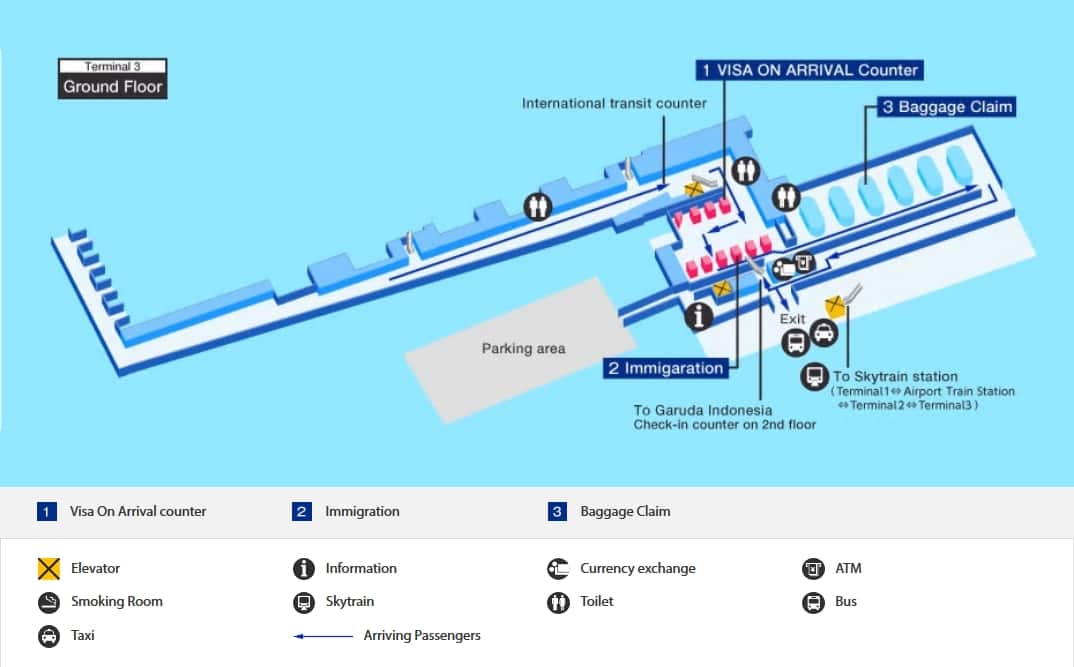
Airport Map Information
Flights operated by ANA Group will arrive at Terminal 3 in the Jakarta Airport.
Immigration
- Please present your passport and return or onwards ticket to a third country.
- VOA (Visa on Arrival) counter is located before Immigration.
- Note: If you have an e-ticket, you are required to show the e-ticket itinerary paper receipt. A screenshot of an e-ticket on your laptop or a photo on your phone may not be accepted.
Customs
All arriving passengers are required to present a Customs declaration form.
Departure Terminal

Check-In
- ANA check-in counters are located in Island B
- NH836 and NH872 check-in is at Islands B1-7
- NH856 check-in is at Islands B8-13
- Boarding gate check-in counters are subject to change; please check at the airport.
- See ANA International Airport Check-In Counter Opening Times.
Lounges
ANA passengers who are eligible to Lounge access will be invited to either Garuda Indonesia Business Lounge or Plaza Premium Lounge.
- Garuda Indonesia Business Lounge is located on Mezzanine Floor
- Plaza Premium Lounge is located near Gate 5
Please present your lounge invitation card which is issued upon check-in. If you don’t have a lounge invitation card, inform the lounge staff. Note: The boarding announcement is not made in the lounges.
Transit
Depending on the airline, the arrival terminal of your flight varies. Please check the website for the relevant airline for the operating terminal.
Transfers from ANA to Other Airlines
ANA Flights to Indonesian Domestic Flights
- Domestic flights with Garuda Indonesia (GA) → Terminal 3 (Same terminal as ANA)
- Domestic flights with airlines other than Garuda Indonesia (GA) → Terminal 1 or 2
- Note: When connecting to a domestic flight, please pick up your checked baggage for Customs clearance at Jakarta Airport.
Connecting Domestic Flights to Garuda, Indonesia (Terminal 3)
After Immigration, please pick up your checked baggage and proceed to the Customs. Go to departure level (2nd floor) for Garuda Indonesia domestic flight check-in.
Connecting Domestic Flights (Terminal 1 or 2)
After Immigration, please pick up your checked baggage and proceed to Customs. Go to Terminal 1 or 2 by Skytrain (available from 4:30 a.m. to 12:15 a.m., departures every 20 minutes).
ANA Flights to International Flights
- International flights with Garuda Indonesia (GA) → Terminal 3
- International flights with airlines other than Garuda Indonesia (GA) → Terminal 2 or 3
Note: You do not need to pick up your checked baggage if it has been checked through to your final destination. Simply present your baggage claim tag to staff upon check-in for your connecting flight. If the final destination on your baggage claim tag is Jakarta (CGK), you have to pick up your baggage at Jakarta Airport. You may also contact ANA ground staff for more details.
Connecting International Flights (Terminal 2)
Upon arrival at Terminal 3, please go through Immigration and then proceed to the Customs. Take Skytrain (available from 4:30 a.m. to 12:15 a.m., departures every 20 minutes) to go to Terminal 2.
Connecting International Flights (Terminal 3)
Upon arrival at Terminal 3, please proceed to international transit counter before Immigration, then go to departure level.
Transfers from Other Airlines to ANA
Indonesian Domestic Flights to ANA Flights
- Domestic flights with Garuda Indonesia (GA) → Terminal 3 (Same terminal as ANA)
- Domestic flights with airlines other than Garuda Indonesia (GA) → Terminal 1 or 2
Connecting from domestic flights in Terminal 1 or 2
Please pick up your checked baggage and transfer to Terminal 3 by Skytrain (available from 4:30 a.m. to 12:15 a.m., departures every 20 minutes) for ANA check in.
Connecting from Garuda Indonesia (GA) domestic flights in Terminal 3
- Upon arrival at Terminal 3, please pick up your checked baggage, if not checked through to your final destination, and proceed to ANA check-in counter located at departure level (2nd floor).
- If your baggage is checked through to your ANA flight, you can proceed straight to the ANA check-in counter upon arrival at Jakarta Airport without picking up your baggage upon domestic arrival. If the final destination on your baggage tag is CGK (Jakarta), please pick up your baggage and check it in again at the ANA check-in counter.
International Flights to ANA Flights
- International flights with Garuda Indonesia (GA) → Terminal 3
- International flights with airlines other than Garuda Indonesia (GA) → Terminal 2 or 3
Connecting from international flights in Terminal 3
Upon arrival at Terminal 3, please contact the arrival airlines staff and follow their instructions to proceed the necessary formalities of transit for your ANA flight or proceed to international transit counter before Immigration.
Connecting from international flights in Terminal 2
Upon arrival at Terminal 2, please go through Immigration and then proceed to the Customs. Transfer to Terminal 3 by Skytrain (available from 4:30 a.m. to 12:15 a.m., departures every 20 minutes) for ANA check in.
Jakarta
On December 19th, 2019 (JST) current information.
Furthermore, the details under "Visa" and "Passport" are for Japanese nationals.
This information is likely to change suddenly, so please contact the relevant official authority (e.g., embassy) for the latest information.
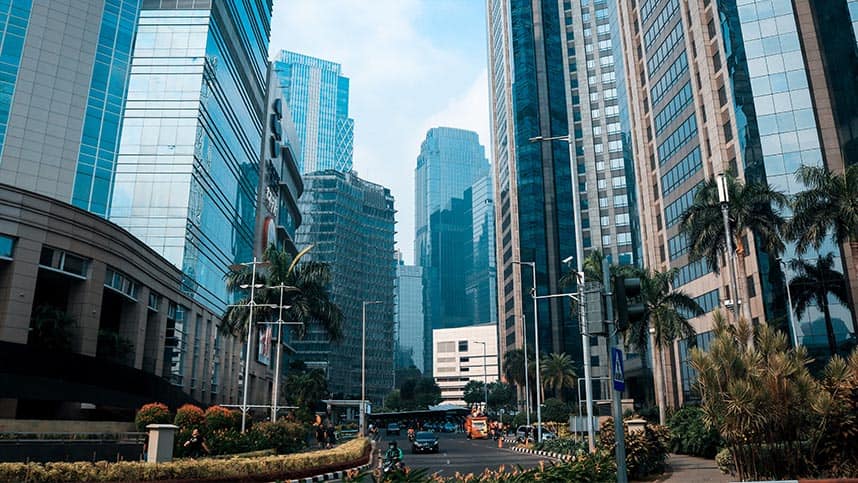
Republic of Indonesia
Official Language: Indonesian
Currency: Indonesian rupiah (IDR)
Time Zone: UTC +7 (WIB
Travelling to Indonesia?
Whether you’re connecting at the airport or will be exploring what this beautiful country has to offer, you’ll find all the helpful tips you need to know on this page—including the current exchange rate, climate information and more. For detailed country information, please visit the embassy’s website.
Immigration and Visa (For Japanese Nationals Only)
Visa
From 2015, Japanese citizens visiting Indonesia for tourism or to see family no longer require a visa for stays up to 30 days in length (no extensions allowed). Eligible at Jakarta, Denpasar, and most other international airports and ports. You also need to obtain a Visa on Arrival (VOA) for 500,000 rupiah at the airport for tourist travel of 31 days or longer or business travel.
Passport
Your passport must be valid for at least six months from the date of entry. It must have at least three consecutive unused visa pages.
- * Visa, passport, and other information is subject to change without notice. Be sure to check with the Embassy, Consulate, or travel agency.
Note for travel to Indonesia
During the Immigration inspection, you must present your ticket for return or onward travel. When traveling with an e-ticket, you must present an e-ticket itinerary receipt.
- * Note that it is not acceptable to simply present an e-ticket on a computer or mobile device.
Quarantine
When visiting from Japan, it is prohibited to bring the following items into Indonesia.
- a. Animals, fish, plants (including animal products, fish products, and vegetable products)
- * Some fruit, vegetables, rice, and other such products may be brought into Indonesia after passing through an export inspection in Japan or obtaining an import permit issued by Indonesia. For details, see the Plant Protection Station website (http://www.maff.go.jp/pps/j/search/ekuni/as/keitai2.html).
Customs
Bringing in e-cigarettes
There are no special restrictions for travelers bringing it in for personal use.
-
*1.Note that if you bring in a large amount, you may be suspected of intending to sell it.
For bringing and possession of tax-free cigarettes
- Tobacco: 200 cigarettes or 25 cigars
- Liquor: 1L
- Perfume: an amount within the range of personal use
Time difference and Daylight Saving Time
Time difference
Indonesia has three time zones: Western (Java, Sumatra, West Central Kalimantan), Central (Bali, Nusa Tenggara, Suawesi, Southeast Kalimantan), and Eastern (Papua). The capital of Jakarta is 2 hours behind Japan (GMT+7), and Bali is 1 hour behind Japan (GMT+8). Daylight saving time is not observed.
Climate
Climate
Because Indonesia is right on the equator and has a tropical climate, it has two seasons, the dry season and wet season. The dry season basically lasts from May to October, and the rainy season from January to April. The humidity is not too high in the dry season, making it a pleasant time. In the rainy season, there are squalls of heavy rain in the afternoon and high humidity.
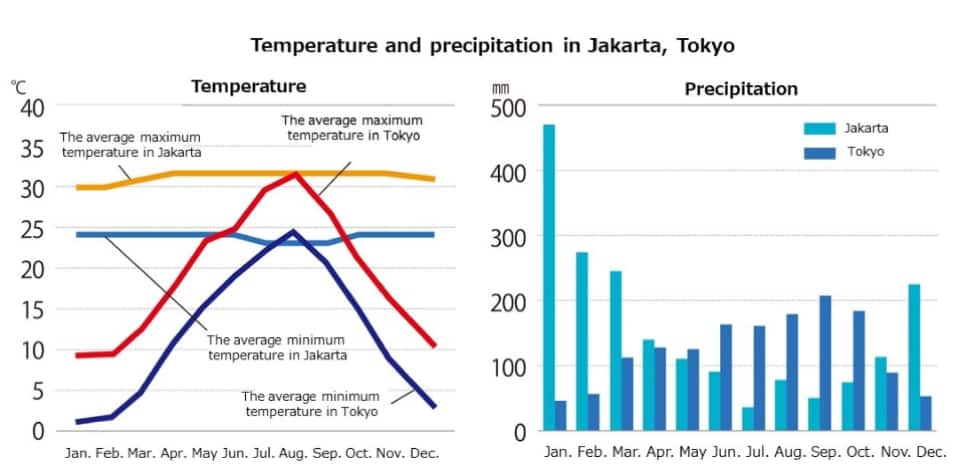
Annual climate table for Jakarta
Currency and Exchange Rate, Tax, Currency exchange, Tip
Currency and Exchange Rate
The unit of currency is the Rupiah (usually written as Rp.). JPY1 is approx. Rp.129 (as of December 3, 2019). There are eight denominations of banknotes in circulation: Rp.500, Rp.1000, Rp.2000, Rp.5000, Rp.10000, Rp.20000, Rp.50000, and Rp.100000. There are five types of coins: Rp.50, Rp.100, Rp.200, Rp.500, and Rp.1000.

Tax
At most mid-level or better hotels, a tax (5% to 11%) and service charge (5% to 10%) are added to the room fee. Often, travelers are charged a service fee that is added onto fees incurred at upscale restaurants and beauty treatment salons.
In 2010, a value-added tax (VAT) refund system was put into place in Jakarta and Bali. Individuals carrying foreign passports are eligible (if the period of stay is within 2 months). The refund is subject to terms, such as spending a total of more than 5 million rupiah (tax excluded) during a single instance of shopping at specified shops.
Tip
Basically, tipping is not required when a service charge is included in restaurant and hotel fees. However, it is advisable to tip when receiving good service or making a difficult request. The amount differs depending on the individual’s level of satisfaction, but the following values serve as references.
- Restaurants: Though it depends on the quality of the restaurant, a tip that is 5% to 10% of the meal charge that is nicely rounded off is given when paying, or change from the bill is left at the table.
- Hotels/Spas: Tip approx. Rp.20000 to hotel porters and persons providing a massage.
- Taxis: It is customary to tell the taxi driver to keep the change.
Voltage and plug
Voltage
Voltage is 220V with a cycle of 50Hz. Generally, plugs are the 2-prong Type C with round pins. When using electric products made for use in Japan, a transformer and adapter are necessary.

Some plugs can be used for Japanese electric products with an adapter
Video and DVD
Video and DVD
The TV and video system (PAL) in Indonesia differs from Japan (NTSC). DVDs have a different region code than Japan (Japan is 2, Indonesia is 3). Many of the pirated editions of DVDs sold in Bali, etc. are region free, but be aware that bringing them into Japan is against the law.
Post offices in Indonesia are called POS INDONESIA. Mail sent by EMS can be tracked online.
Normal Business Hours
Mon. to Sat. 8:00 to 18:00 Also, stamps can be purchased at general stores. At luxury hotels, guests can ask the front desk to mail letters.
Postal Fees
Airmail to Japan costs Rp7000 for a postcard and from Rp.35500 for a sealed letter up to 50g. Mail up to 1kg costs from Rp.482500 by EMS. Normally, mail is delivered in 5 to 10 days to Japan.(EMS takes about three days)
Phone Call
Telephoning Japan from Indonesia
- Dial 001, 007(International telephone identification number)
- 81 (Country Code, Japan )
- X X(Remove the first 0 for area codes)
- 1234-5678 (Other parties telephone no.)
Telephoning Indonesia from Japan
- International Teleph+one Company No.
- 001 (KDDI)*1
- 0033 (NTT Communications) *1
- 0061 (SoftBank Telecom) *1
- 005345 (au Mobile) *2
- 009130 (NTT DoCoMo Mobile) *3
- 0046 (SoftBank Mobile)*4
- 010 (International Identification No.)
- 62 (Country Code, Indonesia)
- 123-4567 (Other parties telephone No.)
-
*1.Not required if you have an international registration with "My Line" or "My Line Plus". See URL My Line/My Line Plus(www.myline.org) for details.
-
*2.au does not require 005345.
-
*3.Pre-registration to World Wing is required for NTT DoCoMo. Does not require 009130.
-
*4.Call are possible without dialing 0046 from SoftBank.
- * For the three cell phone carriers, hold down 0 until + appears, then add the country code and the phone number your wish to dial.
Holiday / National holiday
Holiday / National holiday
The majority of national holidays follow various religious calendars. Aside from New Year’s, May Day, Pancasila Day, Independence Day, and Christmas, be aware of holidays that fall on different dates each year. In addition, the Galungan holiday is only celebrated in Bali, but note that many shops are closed around then (Februar 19 and September 2020).
2020
- January 1: New Year’s
- January 25: Chinese Lunar New Year’s Day*1
- March22: Ascension of the Prophet Muhammad*1
- March 25: Nyepi , Bali’s Day of Silence and Hindu New Year*1
- April 10: Good Friday*1
- May 1: May Day
- May 1: May Day
- May 7: Waisak Day (Buddha’s Anniversary)*1
- May 21: Ascension Day of Jesus Christ*1
- May 22 : Extra holiday declared by the government*1
- May 26 to 27: Extra holiday declared by the government*1
- June 1: Pancasila Day (commemorates the five founding principles of the state)
- June 24 to 26: Indul Fitri*1
- Juiy 31: Idul Adha (Muslim Day of Sacrifice)*1
- August 17: Indonesian Independence Day
- August 20: Islamic New Year*1
- October 29: The Prophet Muhammad’s Birthday*1
- December 24: Extra holiday declared by the government*1
- December 24 : Extra holiday declared by the government*1
- December 25: Christmas Day
-
*1.Holidays that fall on different dates each year.
Language
Language
The official language is Indonesian. Languages unique to various areas in Indonesia are also spoken, such as Javanese and Balinese. English is often understood in places such as resort areas in Bali and Jakarta.
Business hours, etc
Business hours
Below are guidelines for general business hours, which differ by shop, restaurant, and area.
Banks
Mon. to Fri. 9:00 to 16:00, Sat. 9:00 to 12:00, closed on Sun., holidays.
Shops
Normally, shops in cities and tourist areas are open every day from around 10:00 to 21:00. Many convenience stores are open 24 hours.
Restaurants
Normally, restaurants in cities and tourist areas are open every day from around 10:00 to 22:00. Orders are no longer taken from 30min. to one hour before closing. In large cities, some restaurants stay open until very late at night or for 24 hours.
Age Limit
In some instances, there is a child’s entrance fee for children 12 years old or younger at tourist locations, etc. Age restrictions on alcohol consumption and smoking are not regulated by law. Usually, many individuals who drink or smoke start around 17 years old.
Manners
During the Nyepi New Year, going out and lighting fires is prohibited in Bali. Even travelers will be arrested by police if they venture outside the hotel, unless it is an emergency. In addition, do not use the left hand, which is considered the unclean hand, to hold food or shake hands. Also, the head is considered a sacred place where the spirit resides, so people should not touch another person’s head, even the head of a child. Many citizens are Muslims and do not consume alcohol or pork.
Copyright (C) Globe-Trotter Media Partners Inc. All Rights Reserved.
Copyright (C) Diamond-Big Co., Ltd. All Rights Reserved.