


Traveling to and from Bangkok
On this page, you will find the information you need to easily make your way through Bangkok Suvarnabhumi International Airport to your destination.
Guide to Thailand’s Bangkok Suvarnabhumi International Airport
Arrival and departure terminal maps and other information for navigating through Bangkok Suvarnabhumi International Airport.

Arrival Terminal
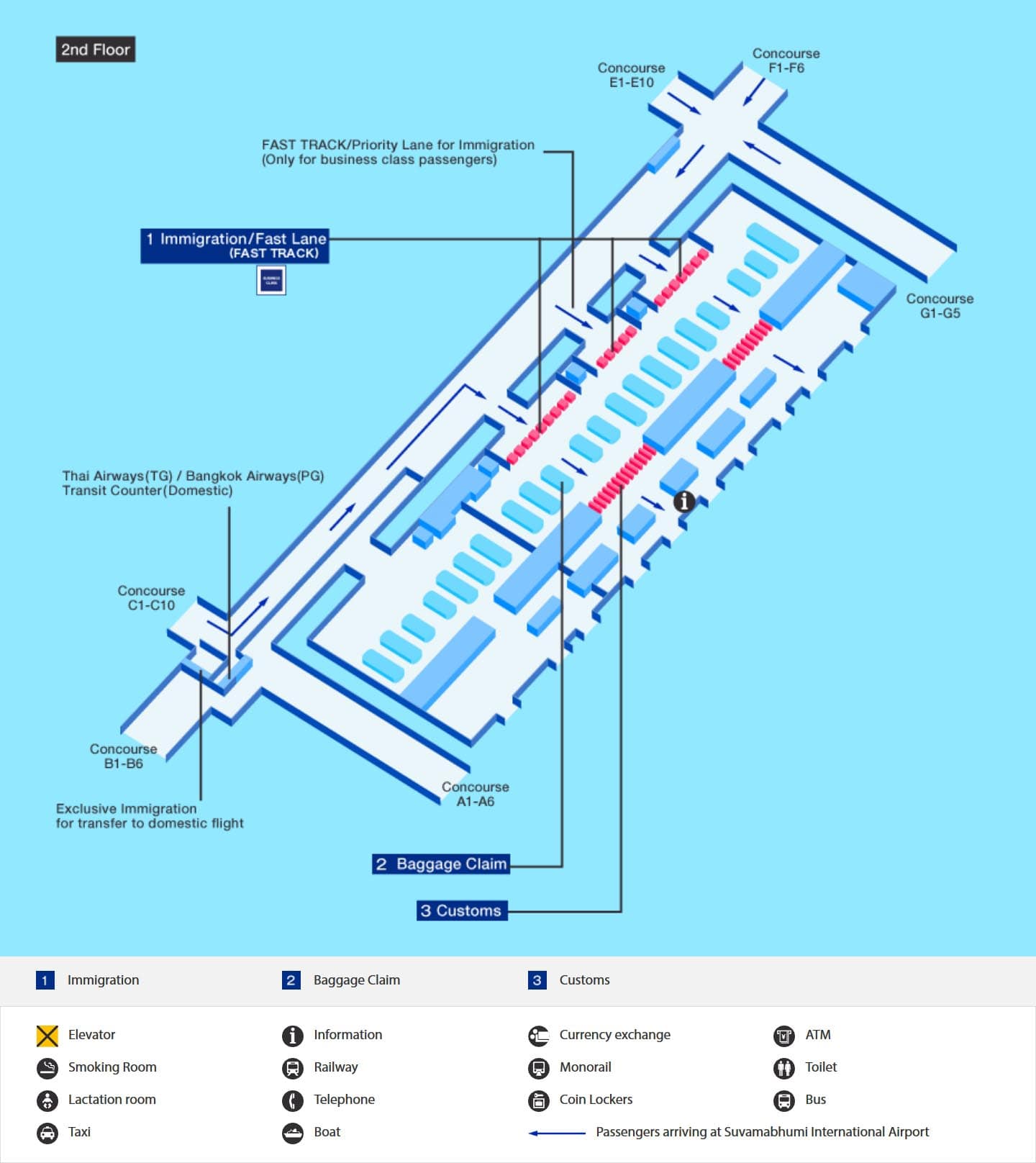
Immigration
- Please present your passport and Immigration card. Please make sure to fill out the Immigration Card in the cabin.
- There are separate Immigration counters for residents and travelers. Travelers need to go to the counter that says "Foreign Passport."
Fast Track Immigration
Fast track Immigration is available to the following customers:
- Business Class
- Disables passengers
- Senior passengers (over the age of 70)
- Expectant mothers
- Passengers with infants
Please show your boarding pass when using this service.
Customs
- Customers with goods to declare must turn in their Customs Declaration forms.
- If you have items to declare, please go to the red counter.
- If you do not have items to declare, please go to the green counter.
Departure Terminal

Airport Information
Learn more about the Airport Lounges.
Check-In
- Please present your passport and boarding pass.
- Since the boarding gate check-in counters might be subject to change; please check at the airport to the day of departure.
- See ANA International Airport Check-In Counter Opening Times.
Security Check and Immigration
Please get on the escalator to pass through the Security Check on the upper floor. You will proceed to Immigration after completing the Security Check. Note: Please prepare your passport and hold onto your appropriate half of the Immigration card and boarding pass.
Fast Track Security Screening
Fast track security screening is available to the following customers:
- Business Class
- Disables passengers
- Senior passengers (over the age of 70)
- Expectant mothers
- Passengers with infants
Please show your boarding pass when using this service.
Transit
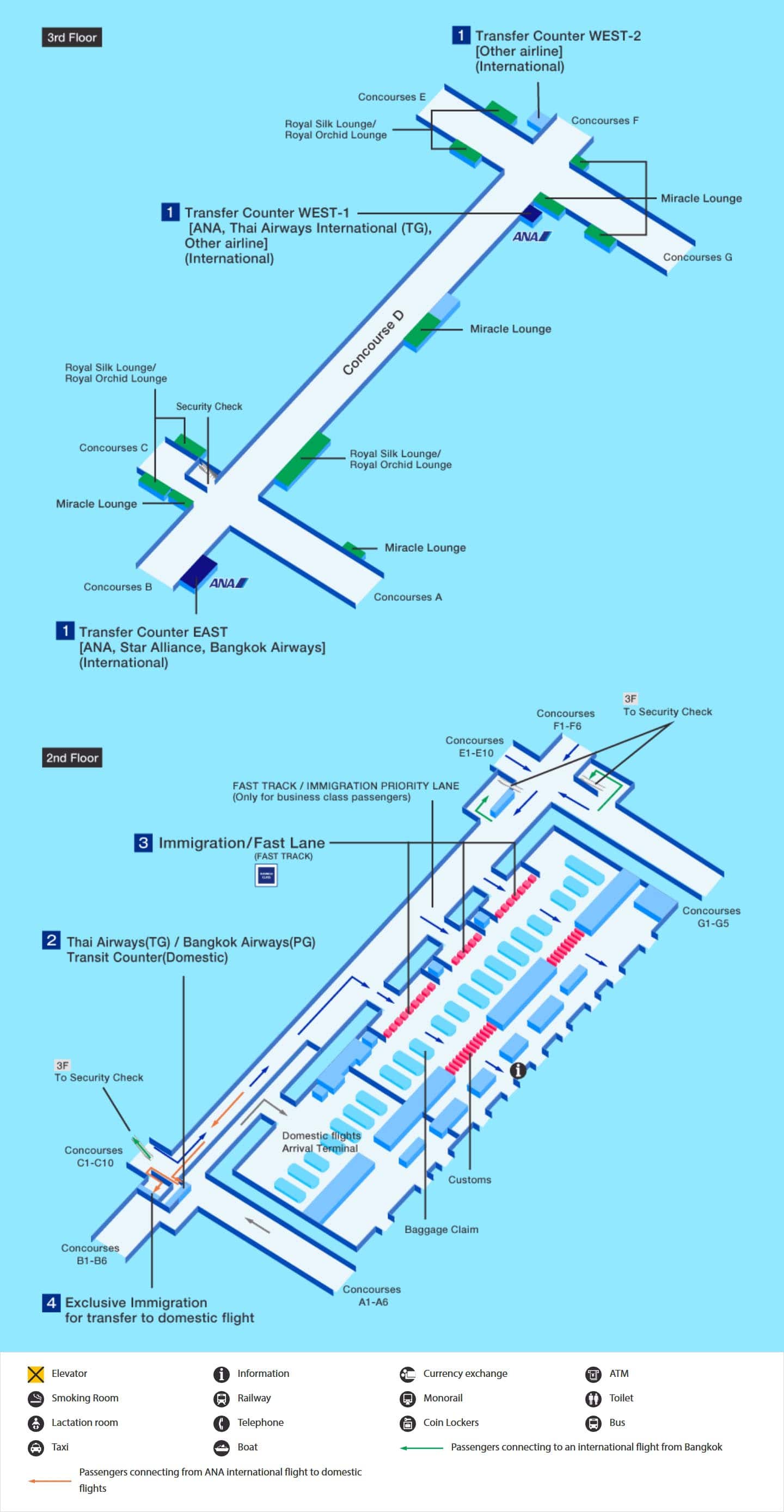
Transiting from ANA to Other Airlines (International Flights)
- After arrival on the 2nd floor, please proceed to the 3rd floor and pass through the security check. Go to the gate for your transit flight after completing check-in at the transit counter for international flights.
- If you’re transiting to an airline that does not have a transit counter on the 3rd floor, please pick up your baggage after Immigration and go through Customs. Then you must check in again at the international flight check-in counter on the 4th floor.
Transiting from ANA to Thai Smile Airways (Domestic Flights)
If transiting to Phuket (HKT), Chiang Mai (CNX), Krabi (KBV), Koh Samui (USM) and Hat Yai (HDY) by Thai Airways (TG):
- After check-in at the Bangkok Airways (PG) transit counter, complete the Immigration at transit inspection area for domestic flights and proceed to the boarding gate of connecting flights.
- Note: The above does not apply if your flight number has “TG” and is operated by Thai Smile Airways (WE).
If transiting to domestic flights other than the above:
- After Immigration, baggage collection and Customs, please proceed to the boarding gate counter of domestic flights on the 4th floor.
If transiting from other airline's international flights and Thai domestic flights to ANA:
- When you have not checked in to ANA flights at departing airports, please check-in at ANA transfer counter (Transfer Counter EAST or WEST) on the 3rd floor and proceed to the ANA boarding gate.
- Except for transfer from a part of airline companies.
Bangkok
On November 27th, 2019 (JST) current information.
Furthermore, the details under "Visa" and "Passport" are for Japanese nationals.
This information is likely to change suddenly, so please contact the relevant official authority (e.g., embassy) for the latest information.
Kingdom of Thailand
Official Language: Thai
Currency: Baht (THB)
Time Zone: UTC +7 (ICT)
Travelling to Thailand?
Whether you’re connecting at the airport or will be exploring what this beautiful country has to offer, you’ll find all the helpful tips you need to know on this page—including the current exchange rate, climate information and more. For detailed country information, please visit the embassy’s website.
Immigration and Visa (For Japanese Nationals Only)
Visa
Travellers may stay for 30 days (29 nights, 30 days) without a visa if they enter Thailand for tourism purposes, have a confirmed travel ticket to leave Thailand within 30 days of entering, and have the equivalent of 10,000 B in cash per person (20,000 B per family). (Travellers may enter from a neighboring country by land or air route up to twice per calendar year.)For an extension more than 30 days, you will need a visa.Inquire with the Thai Embassy for details.
Passport
To enter Thailand, your passport must be valid for at least six months.
Quarantine
When visiting from Japan, it is prohibited to bring the following items into Thailand. Food products with plant ingredients can sometimes be brought in if they have been processed to eliminate disease and pests and raw fruit that is forbidden from bringing in is sometimes permitted if it is frozen to -17.8°C or lower.
- a. Main raw fruit or vegetables
- b. Main plant seeds and all other parts (excluding cigarettes, cut tobacco, and leaf tobacco)
- c. Soil, organic fertilizer, weeds, Quarantine pests
Customs
Bringing in e-cigarettes
Note that you are not allowed to bring e-cigarettes into the country and that possession in Thailand is illegal.
Documents required at the time of Immigration
To enter Thailand, you must fill out an arrival and departure card. Only fill out a Customs declaration form if applicable.
- * Visa, passport, and other information is subject to change without notice. Be sure to check with the Embassy, Consulate, or travel agency.
For bringing and possession of tax-free cigarettes
- Tobacco: Cigarettes 200 pieces, or cigars 250 g
- Alcoholic beverages: 1 bottle (or up to 1 L)
If items exceeding the above amounts are to be brought into the country, a declaration must be made to Customs. Note that failing to provide such a declaration will result in the imposition of penalties consisting of high monetary fines.
Time difference and Daylight Saving Time
Time difference
Thailand is 2 hours behind Japan. When it is noon in Japan, it is 10:00 in Thailand. Daylight saving time is not observed.
Climate
Climate
Thailand is located in the tropics, so it is hot all year round. There is a slight difference in climate between Bangkok and the southern Malay Peninsula, the northern mountain range, and the plateau country in the northeast. Generally, there are three seasons: the rainy season, the dry season, and the hot season.

Average high temperature and average low temperature in Thailand (Bangkok) and Japan (Tokyo)

Monthly precipitation in Bangkok and Tokyo
Currency and Exchange Rate, Tax, Currency exchange, Tip
Currency and Exchange Rate
The unit of currency is the bhat (B), which is subdivided into the satang. B1 is 100 satang. As of November 7, 2019, the exchange rate is 1B, approx. JPY3.6. Primarily distributed banknote denominations are 20B, 50B, 100B, 500B, and 1,000B.Coins are available in 10 B, 5 B, 2B, 1B,50 Satang, , and 25 Satang.

Tax
In Thailand, a 7% value added tax (VAT) is imposed on most products. If conditions are met, the VAT will be refunded, so do not forget to do the paperwork. Taxes imposed on services rendered within Thailand, such as shopping at establishments that cannot process the VAT refund, and payments for hotel fees and restaurant charges, are not eligible for the refund.
Tip
Just like tipping in Japan, leaving a tip at upscale places is a good idea.
- Hotels: Tip bellhops who carry luggage and room service approx. B20.
- Restaurants: At restaurants that include a service charge, leaving change from the bill is fine, and when a service charge is not included, tip approx. 10% of the meal charge (at the most, approx. B100). In any case, be sure to carefully check the bill.
- Taxis: Not required.
- Thai Massage: From about B50 is tipped for an hour and From about B100 for 2 hours, depending on the level of satisfaction. Smaller in regional areas. Do not be fooled even if an employee indicates that tips are JPY1000. That kind of employee does not merit a tip. From about B100, depending on the grade of the spa.
Voltage and plug
Voltage
Voltage is 220V with a cycle of 50Hz. Using electric products from Japan requires a transformer. Plugs are the 2-prong Type A used in Japan, Type BF, Type C, etc.

Plugs are the same shape as in Japan
Video and DVD
Video and DVD
Thailand uses a different video system (PAL) from Japan (NTSC). Products such as videos and DVDs sold in Thailand cannot be played on video players built to Japanese specifications. When watching a video, a region-free multi-player must be used. The DVD region code is 3 (Japan is 2). BD is the same code A used in Japan.
Post Office Business Hours
Though it differs slightly for each post office, usually they are open from Mon. to Fri., 8:30 to 16:30, Sat. 9:00 to 12:00, closed Sun. and holidays. The post office at Suvarnabhumi International Airport is open 24 hours a day, but only carries out mail service.
Postal Fees
Airmail to Japan costs B12 to B15 for a postcard, and B14 for a sealed letter up to 10g. An extra B5 is added for every 10g thereafter.
Phone Call
Telephoning Japan from Thailand A range of International Telephone Company numbers are available, 001 etc. The Country Code for Japan is 81.Remove the first 0 for area codes.
- International Telephone Company Number (Choose one of the following) 001, 007, 008, 009
- 81 (Country Code, Japan)
- xx(Remove the first 0 for area codes and mobile telephone numbers)
- 1234-5678 (Other parties telephone number)
Telephoning Thailand from Japan 66 (Country Code, Thailand), remove the first 0. Then dial using any of the following.
- International Telephone Company No.
- 001 (KDDI)*1
- 0033 (NTT Communications) *1
- 0061 (SoftBank Telecom) *1
- 005345 (au Mobile) *2
- 009130 (NTT DoCoMo Mobile) *3
- 0046 (SoftBank Mobile)*4
- 010 (International Identification No.) *2
- 66 (Country Code, Thailand)
- 1234-5678 (Remove the first 0 for numbers with eight or nine digits)
-
*1.Not required if you have an international registration with "My Line"or "My Line Plus". See URL My Line/My Line Plus(www.myline.org) for details.
-
*2.au does not require 005345.
-
*3.Pre-registration to World Wing is required for NTT DoCoMo. Does not require 009130.
-
*4.Call are possible without dialing 0046 from SoftBank.
- * For the three cell phone carriers, hold down 0 until + appears, then add the country code and the phone number your wish to dial.
Domestic calls from within Thailand:
There are no area codes applied when making calls within Thailand. Fixed lines start with 0 for nine digit numbers, and 08 or 09 for ten digit mobile telephone numbers. The first 0 is required in front of all numbers regardless of where calls are being made in Thailand.
Holiday / National holiday
Holiday / National holiday
The dates of national holidays observed according to the lunar calendar change each year *1. When a national holiday falls on a Saturday or Sunday, it is observed on the following Monday.Buddhist holidays are designated no alcohol days and it is prohibited to sell or serve alcohol on those days *2.
National holidays in 2020 (year 2563 according to the Buddhist calendar)
- January 1: New Year's
- January 25: Chinese New Year (not a public holidays, but some shops close)
- February 8: Makha Bucha (On the day of the full moon, usually in February or March)*1 *2
- February 10: Substitute holiday
- April 6: Chakri Day
- April 13 to 15: Songkran (Thai New Year's) (differs slightly by region)
- May 1: Labor Day
- May 4: Coronation Day
- May 6: Visakha Bucha (On the day of the full moon, usually in May or June)*1 *2
- May 13: Royal Ploughing Ceremony Day (only government offices are closed)*1
- June 3: H.M. Queen Suthida's Birthday
- July 5: Asalha Bucha (On the day of the full moon, usually in July or August)*1 *2
- July 6: Khao Phansa*1 *2
- July 7: Substitute holiday
- July 28: H.M. King Maha Vajiralongkorn's (Rama X's) Birthday
- August 12: The Queen Mother's Birthday
- October 13: Wan Ok Phansa (Leaving Vassa. Not a public holiday, but alcohol is banned.)
- October 13: Rama IX Memorial Day
- October 23: Chulalongkorn Memorial Day
- December 5: National Day (Rama IX's Birthday)
- December 7: Substitute holiday
- December 10: Constitution Day
- December 31: New Year's Eve
Language
Language
The official language is Thai. English is understood to a certain extent in luxury hotels, upscale restaurants, etc., but general understanding is low.
Business hours, etc
Business hours
Below are guidelines for general business hours.
Banks
Mon. to Fri. 9:30 to 15:30, closed on Sat., Sun., holidays (differs slightly by branch).
Department Stores/Shops
Every day around 10:00 to 22:00.
Restaurants
Upscale restaurants close for a time in the afternoon. Some restaurants are only open at night. Food stalls are open from early morning until late at night, so that something is available to eat at anytime.
Convenience Stores
Usually open 24 hours.
Age Limit
Persons under 20 years old cannot purchase or consume alcohol and tobacco.
Manners
Ban on Littering
Bangkok and other cities in Thailand impose a maximum legal fine of B2000 on littering and throwing away tobacco in the streets.
Smoking
Non-smoking Law
In Thailand, smoking is prohibited primarily in public spaces that are sealed and climate-controlled and within 5 meters of their entrances.
Non-smoking During Business Hours:
- Public transportation (buses, taxis, passenger trains, boats, aircraft, school buses)
- Air-conditioned buildings (waiting rooms for vehicle transport, etc., internet cafés, sports facilities, restaurants, elevators, sales areas, hotel lobbies, night spots such as bars)
- Inside buildings (theaters, libraries, barbers, tailors, beauty salons/esthetic salons/spa facilities, pharmacies, department stores, medical facilities without beds, places of religious ceremony, toilets)
- Other (public harbors, telephone booths)
Schools, city halls, sport facilities, medical facilities, museums, public transport, restaurants, etc. Main beaches have been non-smoking since 2017.
Punishment for Violators:
Violators will be fined B2000.
Copyright (C) Globe-Trotter Media Partners Inc. All Rights Reserved.
Copyright (C) Diamond-Big Co., Ltd. All Rights Reserved.