


Traveling to and from Singapore
On this page, you will find the information you need to easily make your way through Singapore Changi International Airport and to your destination.
Guide to Singapore’s Changi International Airport
Arrival and departure terminal maps and other information for navigating Singapore Changi airport.

Arrival Terminal
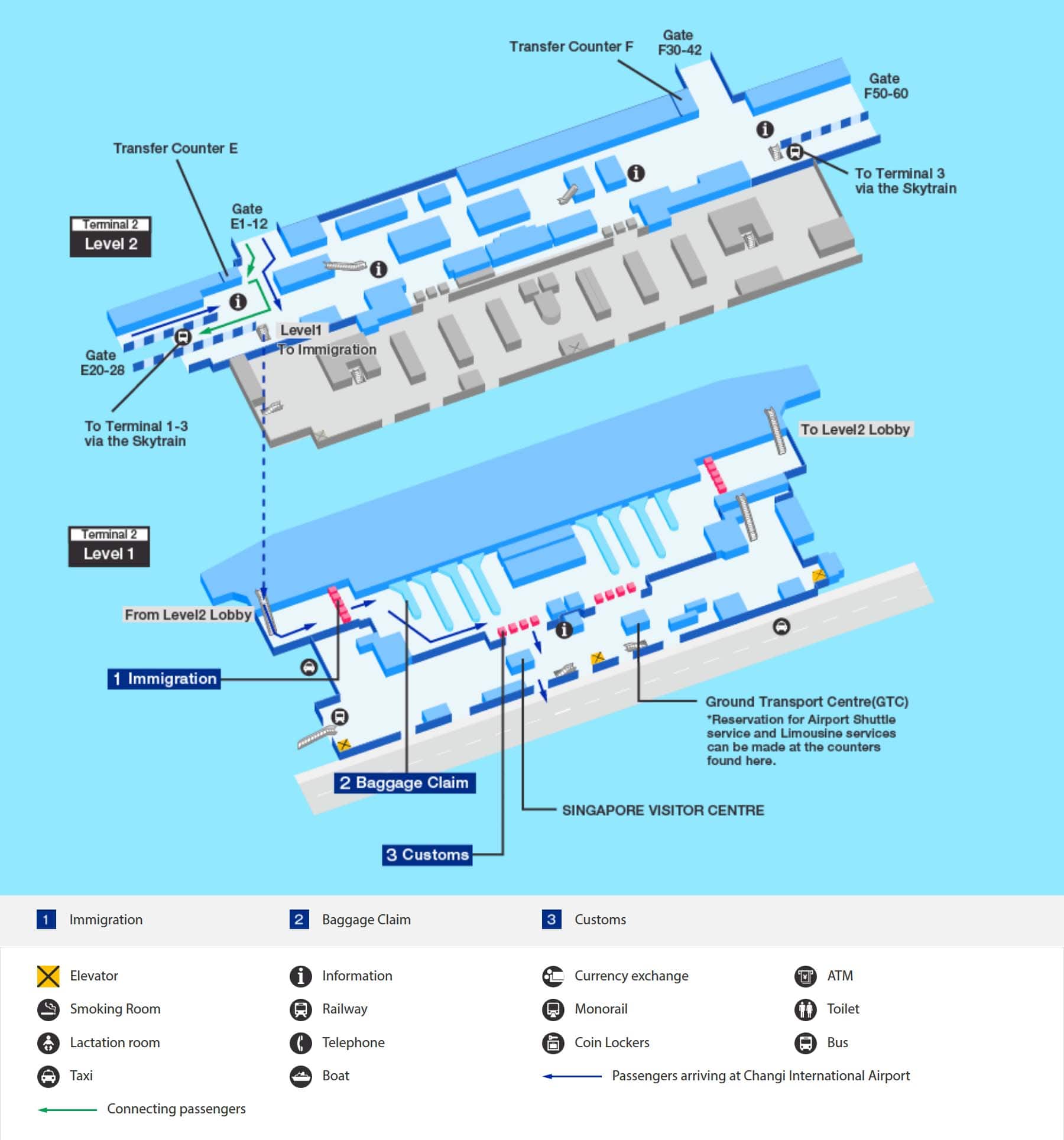
Airport Map Information
Flights operated by ANA group will arrive at Terminal 2 of Singapore Airport. Passengers arriving on level 2 of Terminal 2 should take the escalator down to level 1. Connecting passengers should perform the necessary procedures at Transfer Counter E and then go to Terminal 1 or 3 via the Skytrain.
On level 2, there is also Transfer Counter F, the Skytrain station for Terminal 3, and information counters. Go down to level 1 to go through Immigration, Quarantine, baggage claim and Customs. After Customs, there is an information counter, the Singapore Visitor Center, the Ground Transport Centre (for reservation counters for the airport shuttle and limousine services), bus stops, taxi stands, escalators, elevators and more.
Immigration
Please present your passport, Immigration card and Customs Declaration Form on arrival.
Customs
Please follow the red line if you need to submit a tax application at Customs, or the green line if you don’t need to.
GST (Goods and Services Tax)
In Singapore, most goods are subject to a consumption tax (GST) of 7%, which travelers can get back by applying for a refund. The refund is available only at the shops with display of "TAX FREE SHOPPING," "TAX FREE FOR TOURISTS" or "TAX REFUND." You can also visit a GST counter at the airport.
Departure Terminal

Airport Map Information
Flights operated by ANA group depart from Terminal 2 of Singapore Airport. ANA check-in counters (no. 51 to 56) are a row 5 near Entrance 3 to level 2 of Terminal 2. Self-service check-in machines and ticketing counters are also available nearby (row 6). The early check-in counter is in row 9 and is open from 6:00 a.m. to 11:59 p.m. JST. After check-in, proceed to Immigration.
- If you have items to declare in your checked baggage, please go to the GST tax refund counter before Immigration.
- Passengers seeking a refund of the GST should receive a stamp at Customs, go through Immigration, and proceed to the GST refund counter to get the refund.
After going through Immigration, passengers should proceed to their gate or lounge.
Passengers connecting to ANA from another airline should check in at Transfer Counter E next to the Skytrain Station for Terminals 1 and 3, and then proceed to the boarding gate or lounge.
- Lounge visitors should use the SATS Premier Club Lounge (for Business Class passengers; available from 3 hours prior to departure onward) on level 2, or take the escalator up to level 3 to access the SATS Premier Club Lounge, the KrisFlyer Gold Lounge, and the SilverKris Lounge.
- Get details on Singapore airport lounges
On level 2, you’ll also find the subway exit for arriving passengers, information counters, Skytrain stations, and Transfer Counter F.
Check-In
- Please present your passport and boarding pass.
- Boarding gate check-in counters are subject to change; please check at the airport.
- See ANA International Airport Check-In Counter Opening Times.
Early Check-In
- Opening time: 6:00 a.m. to 11:59 p.m. JST
- Counter: Row 9, Jewel 1st floor
Transit
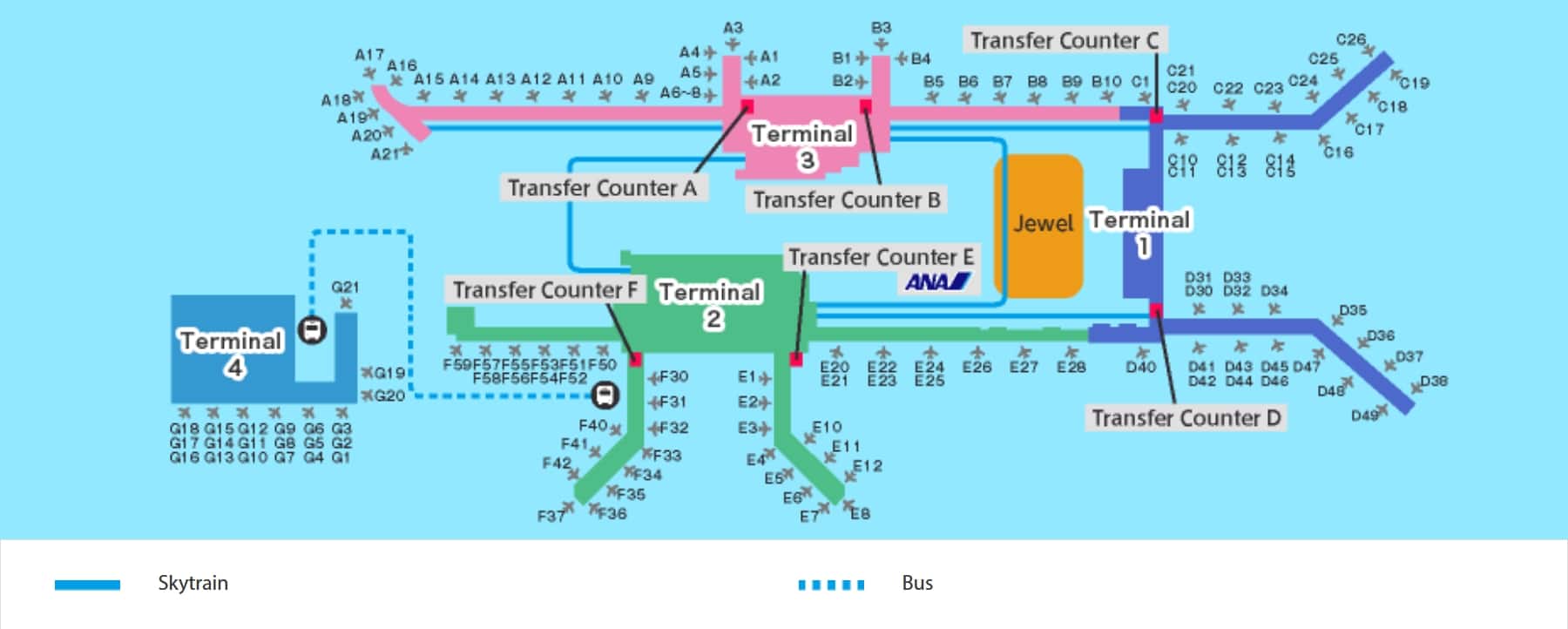
Transfer from ANA to other airlines (domestic and international flights)
- Passengers on flights that depart from Terminal 1 should check in at connecting counter C or D.
- Passengers on flights that depart from Terminal 2 should check in at connecting counter E or F.
- Passengers on flights that depart from Terminal 3 should check in at connecting counter A or B.
Transfer from other airlines (domestic and international flights) to ANA
Please go to Terminal 2 Counter E to prepare for your next flight.
Skytrain shuttles connect terminals 1 , 2 and 3:
- They operate from 5:00 a.m. to 2:30 a.m.
- There is also a walkway that links the terminals.
Passengers connecting to flights leaving Terminal 4:
- From Terminal 2, passengers with a valid boarding pass can take the complimentary 24-hour shuttle bus service to Terminal 4.
- From Terminals 1 or 3: Take the Skytrain to Terminal 2, then take the shuttle bus to Terminal 4.
Singapore
On September 27th, 2019 (JST) current information.
Furthermore, the details under "Visa" and "Passport" are for Japanese nationals.
This information is likely to change suddenly, so please contact the relevant official authority (e.g., embassy) for the latest information.
Singapore
Official Languages: Malay, English, Chinese (Mandarin Chinese), and Tamil.
Currency: Singapore dollar (S$)
Time Zone: UTC +8 (Singapore Time)
Traveling to Singapore?
Whether you’re connecting at the airport or will be exploring what this beautiful country has to offer, you’ll find all the helpful tips you need to know on this page—including the current exchange rate, climate information and more. For detailed country information, please visit the embassy’s website.
Immigration and Visa (For Japanese Nationals Only)
Visa
None required for stays of up to 14 or 30 days (depending on the Immigration officer; usually 30 days for general tourism visits). You also generally need to have a ticket for leaving Singapore (can be an open ticket).
Passport
Your passport must be valid for at least six months beyond the duration of your stay.
- * Visa, passport, and other information is subject to change without notice. Be sure to check with the Embassy, Consulate, or travel agency.
Quarantine
When visiting from Japan, it is prohibited to bring the following items into Singapore.
- a. Chewing gum (however, you are allowed to bring in gum for oral care or medical use that has been approved by the Health Sciences Authority of Singapore)
- b. Rhinoceros horns (any processed or unprocessed form)
- c. Processed products made with endangered plants or animals
- * Violations may result in up to a 5,000 dollar fine as judged by Customs. Serious violations may result in a prison sentence and fine decided by the court.
Customs
Bringing in e-cigarettes
E-cigarettes are prohibited for sale and import in Singapore and you can be fined for possession, so do not bring it into the country.
For bringing and possession of tax-free cigarettes
Tax exemptions are applicable to newly purchased items, such as personal belongings and souvenirs that do not exceed S$600 (S$150 for a stay of up to 48 hours) in total value purchased.
The amount of liquor that an adult can bring in depends on the alcohol content. A combination of the following 3 patterns is exempt from taxes: 1L of spirits and 1L of wine and 1L of beer, 2L of wine and 1 L of beer, or 1L of wine and 2L of beer.
Even a single cigarette must be declared; 1g (or 1 cigarette) is taxed S¢42.7. As a guide, 1 carton of Mevius is taxed approx. S$85.4, but in the case of several cigarettes, often they are tax exempt (however, they must be declared). When declaring items, keep the tax receipt so that proof can be provided anytime. Each cigarette circulated in Singapore is stamped with the SDPC mark, and restrictions on bringing in tobacco are being tightened. Cash amounting to S$20,000 (or the equivalent in other currencies) or more must be declared.
Time difference and Daylight Saving Time
Time difference
Singapore is 1 hour behind Japan. When it is 12:00 in Japan, it is 11:00 in Singapore. Daylight saving time is not observed.
Climate
Climate
Singapore has a tropical monsoon climate, so it has high temperature and high humidity throughout the year. There is a rainy season and dry season. During the rainy season from November to February, it often rains and the temperature drops.
On the other hand, during the dry season from March to October, there is little rain and the air is dry. The sunshine is particularly strong from June to August. However, even in the dry season, there are frequent squalls that last for 1 to 2 hours and suddenly stop. Therefore, carrying raingear is recommended.

Temperatures and precipitation in Singapore and Tokyo
Currency and Exchange Rate, Tax, Currency exchange, Tip
Currency and Exchange Rate
The unit of currency is the Singapore dollar (S$), which is subdivided into the Singapore cent (S¢). S$1 is approx. JPY82 (as of September 3, 2019). There are seven denominations of banknotes: S$2, S$5, S$10, S$50, S$100, S$1000, and S$10000. There are six types of coins: S¢1, S¢5, S¢10, S¢20, S¢50, and S¢1 (the S¢1 coin is not really circulated). Also, in 2013 five new types of coins were issued.

Singapore banknotes and coins
Tax
Normally, products are subject to a 7% consumption tax (GST), and a service charge of 10% is added to hotel fees and restaurant charges. During the F1 Singapore Grand Prix, hotels in the marina area add a 30% tax. Some local eateries do not add a service charge and consumption tax. They are not added at hawkers. When travelers (excluding residents) take purchased goods outside of Singapore, the paid GST can be refunded if specific conditions are met, minus a percentage taken by the company that processes the refund (refunds are not possible for meal and hotel charges).
Tip
Basically, Singapore does not have a custom of tipping.
- Restaurants: If a service charge is added, there is no need to leave a tip, but if good service is received, ordinarily a tip of change from the bill is left.
- Hotels: A tip (from S$2) is given to bellhops and maids for services.
- Taxis: Not necessary.
Voltage and plug
Voltage
Voltage is 230V at a cycle of 50Hz. Generally, plugs are the square, 3-prong type (BF), but some are the round 3-prong type (B3). Using electric products from Japan requires transformers, but most hotels lend them to guests, so this service can be taken advantage of.
Video and DVD
Video and DVD
Singapore uses the PAL TV and video system, which is different from Japan (NTSC), so normal video players used in Japan cannot play DVD and other media from Singapore. Playing them in Japan requires a multi-scan video player and a compatible TV. Or, it requires the use of a service provider that converts DVDs to the Japanese NTSC system. The DVD region code for Singapore is 3, while it is 2 for Japan. Normal DVD players in Japan cannot play DVDs from Singapore.
Postal Fees
Airmail to Japan costs S$0.60 for a postcard or aerogram, while a sealed letter up to 20g costs S$0.70, with an extra S$0.25 added for each 10g thereafter (Takes 3 to 5 days). Sending parcels by air mail is around S$40 for parcels up to 5 kg and S$7 for each additional 1 kg after that (up to 30 kg).
Phone Call
Telephoning Japan from Singapore
- Dial 001 (International telephone identification number)
- 81 (Country Code, Japan)
- X X(Remove the first 0 for area codes)
- * Remove first 0 from mobile telephone numbers starting with 090 or 080
- 1234-5678 (Other parties telephone no.)
Telephoning Singapore from Japan
- International Telephone Company No.
- 001 (KDDI)*1
- 0033 (NTT Communications) *1
- 0061 (SoftBank Telecom) *1
- 005345 (au Mobile) *2
- 009130 (NTT DoCoMo Mobile) *3
- 0046 (SoftBank Mobile)*4
- 010 (International Identification No.)
- 65 (Country Code, Singapore)
- 6123-4567 (Other parties telephone No.)
-
*1.Not required if you have an international registration with "My Line" or "My Line Plus". See URL My Line/My Line Plus(www.myline.org) for details.
-
*2.au does not require 005345.
-
*3.Pre-registration to World Wing is required for NTT DoCoMo. Does not require 009130.
-
*4.Call are possible without dialing 0046 from SoftBank.
Holiday / National holiday
Holiday / National holiday
Below are national holidays in 2020.
- January 1 to 3: New Year's
- January 25 to 26: Chinese New Year (lunar calendar New Year)( As the 26th falls on Sunday, the 27th is a substitute holiday. )*1
- April 10: Good Friday*1
- May 1: Labor Day
- May 7: Vesak Day*1
- May 24: Hari Raya Puasa ( As the 24th falls on Sunday, the 25th is a substitute holiday. )*1
- July 31: Hari Raya Haji
- August 9: National Day (National Foundation Day)
- November 4: Deepavali (may change)*1
- December 25: Christmas
-
*1.National holidays fall on different days, depending on the year.
Language
Language
The official languages are Malay, English, Chinese (Mandarin Chinese), and Tamil.
Business hours, etc
Business hours
Below are guidelines for general business hours, which differ by shop, department store, restaurant, etc.
Banks
Generally Mon. to Fri. 9:00 to 16:30 (some places open until 18:00); Sat. 8:30 to 13:00 (some places open 10:00 to 14:30), closed on Sun., holidays.
Shops
11:00 to 21:00. Many department stores and large shopping centers open from 10:00. Seven-Eleven and Cheers convenience stores are found throughout towns and are often open 24 hours.
Restaurants
10:00 to 22:00. Some restaurants serve breakfast, and some close between lunch and dinner. Some food courts stay open until late at night.
Age Limit
Tobacco and alcohol is restricted to persons 18 years old and older. Entrance to persons under 18 years of age is prohibited for movies rated R (A). In the case of a NC-16 rating, persons under 16 years old are prohibited from entering. Identification, etc. must be shown. Persons under 21 are prohibited from entering casinos.
Manners
Regulations
Various regulations and laws have been established to unify this small island country where many races live together. Fines to thoroughly enforce them have also been established. Even travelers are subject to fines, so care must be taken.
The primary example of a fine is a maximum of S$1000 imposed for littering. There are also fines for smoking outside of designated smoking areas, and spitting/hawking phlegm in public areas. There is a fine for eating/drinking in the MRT (trains). Bringing chewing gum into Singapore is prohibited. Also, crackdowns on drugs are extremely harsh. For instance, even foreigners who bring in an excess of specific amount of drugs will not get off with just a fine. A heavy punishment is imposed.
Taboos
Since there was a three-year period when the Imperial Japanese Army occupied Singapore during WWII (Shonan Island era), some elderly Singaporeans harbor anti‐Japanese sentiments. There are no particular religious taboos, but avoid wearing clothing that exposes the skin when visiting Islamic temples.
Smoking
Both indoor and outdoor eating/drinking facilities are non-smoking, excluding some designated smoking areas. Even nightspots are non-smoking, but there are some establishments with smoking areas (restricted to those authorized by the National Environment Agency). Areas where smoking is allowed are required by regulation to clearly mark the place with a symbol (floor markings, table colors, etc.) or sign.
Copyright (C) Globe-Trotter Media Partners Inc. All Rights Reserved.
Copyright (C) Diamond-Big Co., Ltd. All Rights Reserved.