


Traveling to and from Japan
On this page, you will find the information you need to easily make your way through Narita International Airport to your destination.
Guide to Japan’s Narita International Airport
Arrival and departure terminal maps and other information for navigating through Narita International Airport. Note: Typically, ANA is in the South Wing of Terminal 1. As of February 2019, ANA-operated flights may arrive at the North Wing at Terminal 1—please check the airport’s website under “Flights Today” for the latest information.

Arrival Terminal
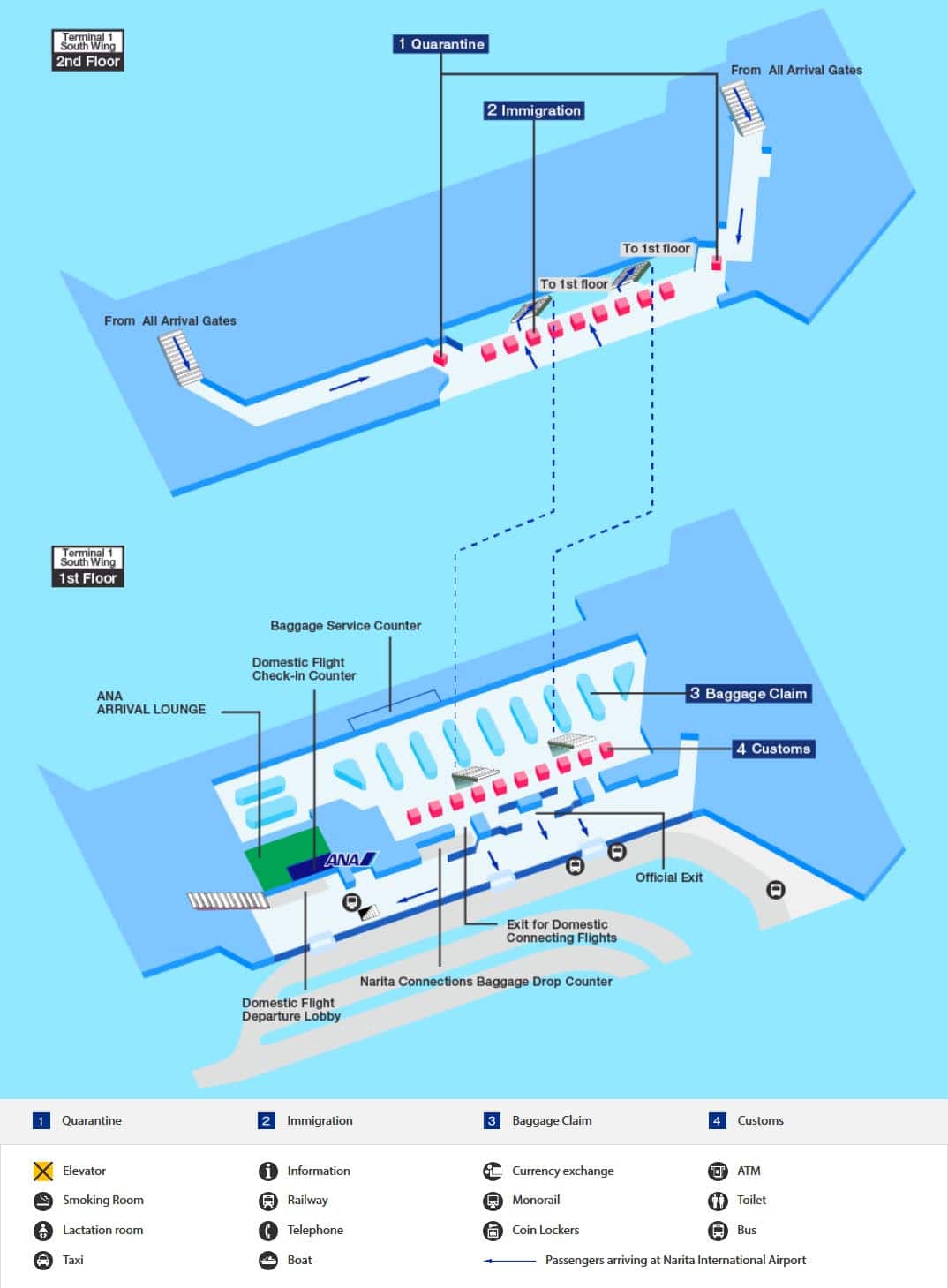
Immigration
Please present your passport and Immigration card.
Customs
Customers with goods to declare must turn in their Customs Declaration forms.
Departure Terminal

Boarding Procedures
- *From May 17, 2020, all passenger's boarding procedures will temporarily be accepted in Zone B.
- Zone B: First class, business class and economy class boarding procedures
Passengers who need special assistance, please proceed to Zone B.
Security Check Priority Lanes
The following customers can use the priority security lanes:
- ANA Platinum Service Members
- ANA Super Flyers Card Members
The following customers can use the Star Alliance Gold Track (after showing their boarding pass):
- Star Alliance Gold members
- Please show your membership status card in addition to your boarding pass.
- First Class customers
- Business Class
For more information, see ANA Duty Free Shop.
Check-In
- Please present your passport and boarding pass.
- Since the boarding gate check-in counters might be subject to change; please check at the airport to the day of departure.
- Please check-in at the counter of the operating airline when taking a code share flight operated by another airline. For details on code-share flights, please go here.
- See ANA International Airport Check-In Counter Opening Times.
Transit

International Flights
Terminal 1 transits:
Please go through the Departure Concourse on the third floor after you have cleared Transit Inspection on the fourth floor.
Please clear Transit Inspection and go through the Transit Counter on the third floor if you have not completed boarding procedures for your next flight.
Terminal 2 transits:
Please use the connecting bus in the terminal for transportation between terminals.

International and Domestic Flights
Transit from international flights to domestic flights:
- When connecting to ANA domestic flights at Narita Airport, please check-in your baggage at the Narita Connections Baggage Drop Counter after you have completed the arrival process.
- When connecting to domestic flights of other airlines, please go through the official exit and go to the terminal 2 by the connecting bus in the terminal.
- When connecting to domestic flights at Haneda Airport, please go through the official exit and go to Haneda Airport after you have completed the arrival process.
Note: When you have check-in baggage from international airports, please make sure to pick up your baggage at the first entering point in Japan. You must drop off your baggage after proceeding Customs inspections.
Transit from domestic flights to international flights in Terminal 1:
Please use the dedicated facilities for transit passengers.
- If you are connecting to an international flight departing from the South Wing of Terminal 1 and you have already checked in your baggage, please proceed to Transit Inspection from your domestic flight's arrival gate. After completing the security check and departure procedures, proceed to your international flight's departure gate.
- If you are connecting to an international flight departing from the North Wing of Terminal 1, please proceed to the 4th floor of Terminal 1, North Wing from the arrival lobby.
Transit from domestic flights to international flights in Terminal 2:
- If you are connecting to an international flight departing from Terminal 2, please complete arrival procedures. Then, proceed to the shuttle bus stop located on the 1st floor to ride the shuttle bus to Terminal 2.
Lounge

Learn more about the Airport Lounge.
Instructions for Tokyo (Narita)
Busy Periods
- Airports may be very crowded during long public holidays in Japan such as the year-end/New Year period, Golden Week and during the Bon Festival.
- Please arrive at the airport with adequate time to spare.
- Nearby roads may be very congested and parking facilities may operate at full capacity during the period above.
- We recommend using public transportation. When traveling to the airport by car, please check the availability status of the parking facilities at the relevant airport.
- Reminder: You can check-in online 24 hours before your departure to avoid check-in at the airport.
See below for approximate time required for procedures during busy periods. Note: Time limits may be in place at security checkpoints during busy periods.
| Check-in Procedure | Congested Periods | Approximate Required Time |
|---|---|---|
| Baggage check-in | 4 p.m. to 6 p.m. | 15-20 minutes |
| Security | 4 p.m. to 6 p.m. | 20-30 minutes |
Facility Charges for Domestic Routes
There are Passenger Facility Charges (PFC) for domestic routes at Narita International Airport. Note: When flight tickets are purchased, the fare will include an airport fee. For detail on fees, please visit the Narita International airport website and/or view this PDF (Passenger Service Facility Charges after Opening of Terminal 3).
ANA flights use Terminal 1 and the fees are outlined below.
| Applicable Charges (Handling of International Flight Tickets) | Adults (12 years or older) | Children (2-12 years old) |
|---|---|---|
| Japan Domestic Routes arriving or departing at Narita International Airport | 440JPY | 220JPY |
Security Interview for Passengers Traveling to U.S.
Due to Transportation Security Administration (TSA) security requirements, security questioning is required at the Narita airports for all passengers traveling to the USA. Thank you for your kind understanding and cooperation.
Hand Baggage and Unaccompanied Baggage
- All passengers entering Japan are required to submit a Customs Declaration Form for hand baggage and unaccompanied baggage to the Customs Officer.
- Please note that if a passenger does not submit the Customs Declaration Form, the Customs inspection may take some time, and the passenger may not be permitted to take their baggage into Japan.
- The Customs Declaration Form is available for printing in advance (A4 size) from the Japan Customs website.
- For details, see the Japan Customs website.
Immigration Procedure
As part of efforts to combat terrorism, anti-terror measures have been put in place to use the personally identifying information provided to Immigration. Under a revised section of the Immigration Control and Refugee Recognition Act, foreign nationals will now have their fingerprints and a photograph taken.
Exempt Individuals
The following foreign nationals entering (or re-entering) Japan do not have to get their photo or fingerprints taken:
- Special permanent residents
- Children under age 16
- Persons seeking to conduct activities that apply under a “diplomacy” or “official business” visa status
- Persons invited by the head of a national administrative body
- Persons prescribed by decree of the Ministry of Justice in accordance with 3 or 4
Immigration Procedure Flow
- Submit passport and Embarkation Card For Reentrant (ED card) to the Immigration Officer.
- After receiving instruction from the Immigration Officer, place both index fingers on the fingerprint reader, while your fingerprint information is read electromagnetically.
- The camera above the fingerprint reader will take your photograph.
- You will be interviewed by the Immigration Officer.
- The examination is over once the Immigration Officer returns your passport and other documents.
Important Notice
- Foreign nationals who refuse to have their fingerprints or photograph taken will be refused entry to Japan, and ordered to leave.
- Incomplete ED cards may result in extremely long Immigration processing times, so please ensure you do not miss any items on the ED card.
- For more details, see the Japan Ministry of Justice website.
Quarantine
Note: All customers arriving from Southeast Asia must submit a health questionnaire.
Plant Protection Act
When bringing plants into Japan, it is legally required to submit a Phytosanitary certificate issued by the government of the exporting country. Based on the Plant Protection Act, you will have to undergo import inspection and, if you don’t have these Phytosanitary certificates, the plants will be disposed. For the latest information on the plant Quarantine program, please refer to the Ministry of Agriculture, Forestry and Fisheries - Plant Protection Station website.
Note: Plants are defined as fruits, vegetables, cereals, cut or dry flowers, seeds, or seedlings. Any violations might result in legal penalties (e.g., three-year jail sentence and/or a maximum fine of one million yens).
Prohibited Imports
The following are examples of plants and/or plant-related items that cannot be brought into Japan:
- Mango
- Papaya
- Lychee
- Longan
- Blueberry
- Mangosteen
- Rambutan
- Guava
- Pitaya (dragon fruit)
- Cashew nut
- Lianwu
- Balsam pear
- Marrow bean
- Chili pepper
- Tomato
- Soil (including potted plant)
- Injurious insects that are harmful to plants
- Rice straw and unhulled rice (except for those brought in from the Korean Peninsula and Taiwan)
Plumeria Plants From Hawaiian Islands
As of May 24, 2017, it is prohibited to import Plumeria plants and cuttings from the Hawaiian Islands into Japan unless certain conditions are met.