


Your Guide to Traveling to Japan
Find out everything you need to know about traveling to Japan, including entry requirements, climate, currency, and electrical voltage
Immigration and Visa Information
Visa
You do not need a visa for stays of up to 90 days for the purpose of business, a conference, tourism, or visiting friends or relatives.
A visa is required for longer stays, for study, or for carrying out activities for which you will be paid in Japan.
Passport
Your passport should be valid until at least the end of your stay.
Visa, passport and related information is subject to change without notice. Please check with the embassy, consulate, or travel agency.
Quarantine
Any animals or animal products (e.g., beef, beef jerky, sausages) you bring into Japan must undergo animal quarantine inspection. Plants must undergo plant quarantine inspection.
Migration Card
Fill out the required fields in the form that is distributed during your flight or available at the tables in the immigration inspection area.
Customs
All individuals entering Japan must submit a Customs Declaration (Declaration of Personal Effects and Unaccompanied Articles) form.
Immunizations
There are no immunizations that are required for entering Japan.
Bringing Tax-Free Cigarettes, Alcohol and Perfume into Japan
These limits apply:
- Tobacco only: 200 foreign cigarettes and 200 Japanese cigarettes
- Cigars only: 50
- Alcohol: three bottles (760 mL each)
- Perfume: 2 ounces (1 ounce is approx. 28 mL).
- Excludes eau de cologne and eau de toilette
Climate in Japan
The islands of Japan are mostly in the temperate zone, and experience four distinct seasons. However, since the country stretches lengthwise North to South, it has different climates within those seasons—from the subpolar zone in Hokkaido to the subtropical zone of Okinawa.
- Spring (March to May): Many days are relatively warmer. Although it often becomes hot during the daytime, it is best to have a light jacket.
- Summer (June to August): It is often both hot and humid.
- Autumn (September to November): The number of less humid, more comfortable days increases.
- Winter (December to February): Seasonal winds from the continents result in plenty of snow on the Sea of Japan side and a cold wind blowing on the Pacific side. The temperature drops quite low as well, so a coat or down jacket is a must.
June and July are the rainy season for most of Japan; Hokkaido is the exception.
From July to October, tropical cyclones called typhoons can arise in the southern ocean waters and move north. In particular, Okinawa and the Kyushu region can experience strong winds and torrential rain.
Currency, Exchange Rate, Taxes and Tipping
Currency
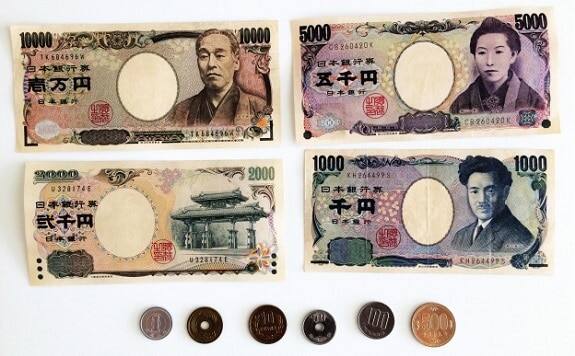
The unit of currency in Japan is the yen. It is denoted by ¥. There are six types of coins and four types of banknotes currently in distribution. (Some are pictured here.) Coins in distribution are 1, 5, 10, 50, 100, and 500 yen coins. Banknotes in distribution are 1,000, 2,000, 5,000, and 10,000 yen notes. However, there are very few 2,000 yen notes in distribution and they are rarely seen.
Exchange Rate
As of March 2020, 1 USD = approximately 107 yen
You should check the official exchange rate at the time of your travel.
Currency Exchange
Currency can be exchanged at the foreign exchange counter at banks or post offices. There also are currency exchange counters at Japanese airports where you can exchange your money after arrival in Japan.
Tipping in Japan
Although tipping is not customary, a service charge may be added to your bill. Furthermore, the traditional custom of handing over some money folded into paper or slipped into a decorative paper envelope as a gratuity to the waitress remains at some upscale Japanese inns (ryokans).
Voltage and Plugs
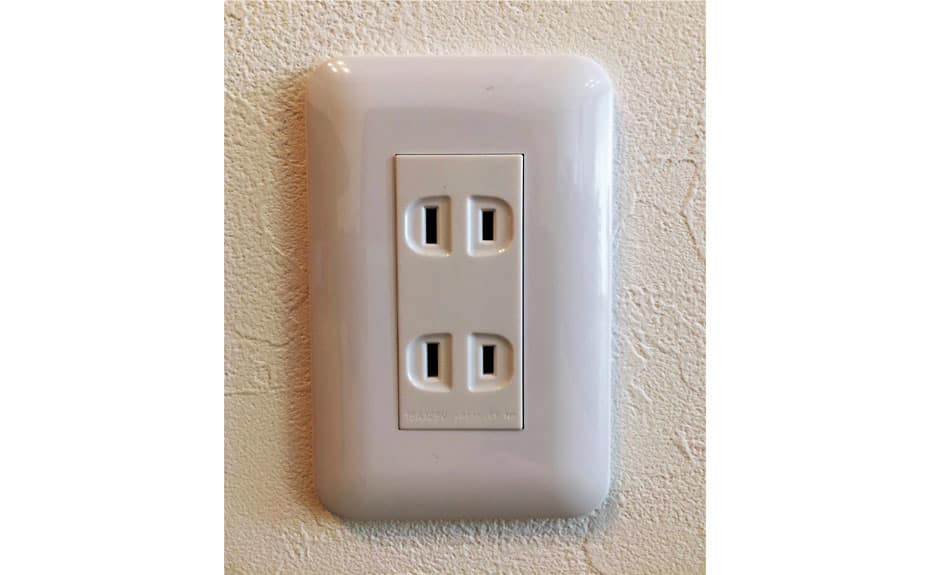
The voltage in Japan is 100 Volt. Japanese electrical plugs are most commonly non-polarized and ungrounded with just two pins.
Most equipment you bring, such as laptops and smartphone chargers, will work fine in Japan without an adapter; however, certain equipment, especially equipment involving heating (e.g., hair dryers), may not work properly or even experience damage.
Voltage in Japan differs between Eastern Japan (including Tokyo, Yokohama, Tohoku, Hokkaido) where the frequency of electric current is 50 Hertz, and Western Japan (including Nagoya, Osaka, Kyoto, Hiroshima, Shikoku, Kyushu) where it is 60 Hertz. But most equipment is not affected by this frequency difference.
Video, DVD and Blu-Ray
Video and DVD
The TV system in Japan is NTSC, and the DVD region code is region 2. Note that DVDs purchased in other countries may not be able to be played on a Japanese DVD player.
Blu-ray
Japanese Blu-rays are region code A. Blu-rays with region code A cannot be played on video players with a different region code.
Sending Mail While in Japan
Although the hours vary depending on the branch or services offered, general over-the-counter mail services are usually available from 9:00 a.m. to 4:00 p.m. Some branches have a Yuyu counter that offers postal services on Saturdays.
Sending postcards to any country via airmail is available at the post office for 70 yen. There are four types of international mail services, each with different delivery rates and delivery times: Express Mail Service (EMS), airmail, Economy Air (SAL), and surface mail.
Calling to and from Japan
Calling to Japan from the Outside
Using the example phone number (03) 1234-5678, follow these steps:
STEP 1
Dial your location’s international exit code.
STEP 2
Dial 81 (the country code for Japan).
STEP 3
Dial 3 (Remove the first 0 for Japan area codes)
STEP 4
Dial 1234-5678.
Calling to Foreign Countries from Japan
Using the example phone number (213) 123-4567 (the United States), follow these steps:
STEP 1
Dial 010, Japan’s international access code
STEP 2
Dial 1, the country code for the US
STEP 3
Dial 213, the area code
STEP 4
Dial 123-4567
Japan National Holidays
In Japan, national public holidays are stipulated by the Act on National Holidays.
When a public holiday falls on a Sunday, the following Monday is a substitute holiday. If a weekday falls between two public holidays, it also becomes a national holiday.
- The Act on National Holidays has been revised, and Health and Sports Day will be permanently renamed as Sports Day from 2020 onward.
- For the year 2020 only, Marine Day will be on July 23, Sports Day will be on July 24, and Mountain Day will be on August 10.
| Date | 2020 National Holidays |
|---|---|
| January 1 | New Year's Day |
| January 13 | Coming of Age Day |
| February 11 | National Foundation Day |
| February 23 | The Emperor's Birthday |
| February 24 | Substitute Holiday |
| March 20 | Vernal Equinox Day |
| April 29 | Showa Day |
| May 3 | Constitution Memorial Day |
| May 4 | Greenery Day |
| May 5 | Children's Day |
| May 6 | Substitute Holiday |
| July 23 | Marine Day |
| July 24 | Sports Day |
| August 10 | Mountain Day |
| September 21 | Respect for the Aged Day |
| September 22 | Autumnal Equinox Day |
| November 3 | Culture Day |
| November 23 | Labor Thanksgiving Day |
Language
Japanese is the official language of Japan.
English is often used at hotels and restaurants that cater to foreigners but is not widely spoken.
Business Hours: Banks and Shopping
Banks
Banks are generally open Monday to Friday, from 9:00 a.m. to 3:00 p.m. (closed weekends and holidays).
- Currency exchange is not available unless there are over-the-counter services.
ATMs are generally available from 8:00 a.m. to 11:00 p.m. on weekdays and Saturdays and until 9:00 p.m. on Sundays.
Restaurants
Hours vary by establishment. Casual dining chain restaurants are generally open from 7:00 a.m. until late at night, with some open 24 hours.
Department Stores and Shops
Most stores are open from 10:00 or 11:00 a.m. to 8:00 or 9:00 p.m. The restaurant floors of most department stores stay open until 10:00 or 11:00 p.m.
Convenience Stores
Most convenience stores are open 24-hours a day, 365-days a year.
Drinking and Smoking Rules
Drinking
Alcohol use is prohibited by those under 20 years of age.
Smoking
If you need to smoke, please do so only in designated areas.
- Smoking is prohibited for those under 20.
- Some regions also have bylaws prohibiting smoking while walking.
- An increasing number of eating establishments are creating separate smoking areas or rooms, and some restaurants, cafes and other spaces do not allow any smoking during lunchtime.
Using Restrooms in Japan
There is generally no fee to use restrooms in parks and other public facilities. If there are separate men's and women's restrooms, they are usually marked with a silhouette of a person in a skirt for the women's restroom and a person in pants for the men's restroom.
Some places have multipurpose restrooms that are large enough to fit a wheelchair or caregiver with a child, and are often fitted with handrails, a diaper changing table, and other equipment.
Manners
A few pointers for understanding manners in Japan:
- It is customary to remove your shoes when entering certain indoor spaces.
- When riding an escalator, it is customary to stay on one side to let people who are in a hurry pass on the other side.
- When getting on an elevator or train, wait first for those getting off, as they have priority.
Japan Connected-free Wi-Fi
Use this app to connect easily to free Wi-Fi spots in many areas of Japan.
- Service available to specific service provider.
Download the “Japan Connected-free Wi-Fi” app from:
Please install the app and complete the registration for use before your travel.
For more details, visit the Japan Connected-free Wi-Fi website.
Making Reservations for Hotels in Japan
You can use these English-language sites to find hotels and ryokan (Japanese style accommodation) across Japan:
Visit Japan Campaign with ANA
With ANA, discover the secrets and surprises of Japan, a country where the present and the past live side by side in perfect harmony. Although Japan is a place steeped in history and tradition, it is also a place with metropolitan cities filled with energy and excitement. Nonetheless, there is still a culture that is centuries old and traditions are still preserved in many parts of the country. Learn more about Japan, The Land of the Rising Sun.
Fly with ANA or one of the Star Alliance Member airlines and enjoy your stay in Japan!
Save on Your Stay in Japan
ANA Mileage Club members can save up to 20% discount on hotel room rates at our IHG hotel partners. Just show your member card and save. You also can accrue miles by staying at some hotels.
- Does not apply to reservations made through travel agencies or at special discount rates.
- Not available with Temporary Cards.
Find out more and reserve a room with this Saving on your Stay in Japan.