


Traveling to and from Myanmar
On this page, you will find the information you need to easily make your way through Yangon International Airport to your destination.
Guide to Myanmar’s Yangon International Airport
Arrival and departure terminal maps and other information for navigating through Yangon International Airport.

Arrival Terminal
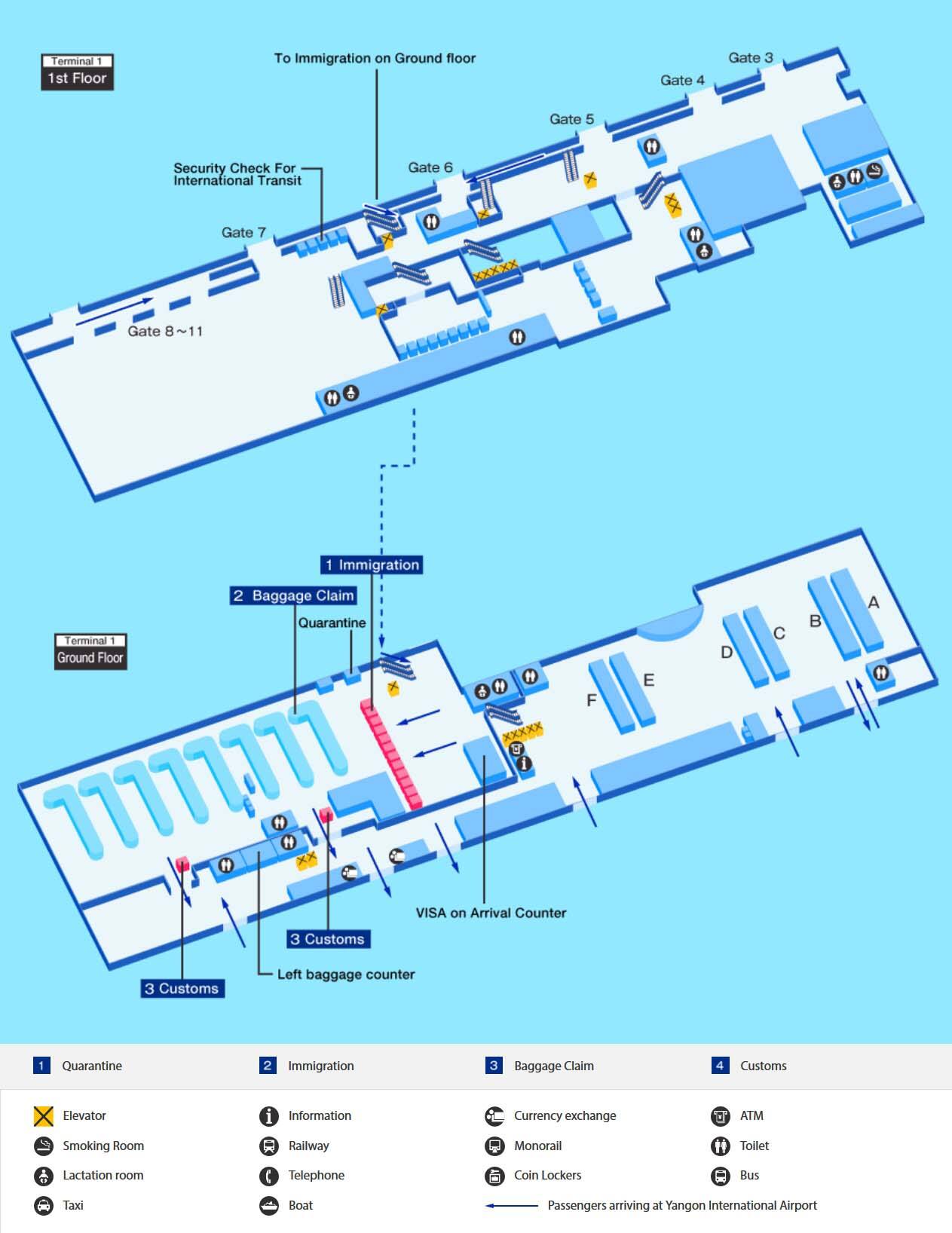
Airport Map Information
Flights operated by ANA Group will arrive at Terminal 1.
Immigration
Please present your passport.
Customs
- Customers with goods to declare must turn in their Customs Declaration Forms.
- Note: All baggage is subject to X-ray inspection and if you bring fresh food, it may not be able to go through customs.
Departure Terminal

Flights operated by ANA Group will depart from Terminal 1. Learn more about the Airport Lounge.
Check-In
- Please present your passport and boarding pass.
- Since the boarding gate check-in counters might be subject to change, please check at the airport to the day of departure.
- See ANA International Airport Check-In Counter Opening Times.
Security Check
Security Check is done just before the check-in counter area, but there is another Security Check after Immigration before the boarding gate.
Immigration
Go to the boarding gate after completing the Immigration check. Please prepare your passport and your boarding pass.
Transit
Passengers Transiting from ANA to Domestic Flights in Myanmar
After completing the Immigration, use the shuttle bus from 1st floor to proceed to the domestic terminal (Terminal 3).
Yangon
On December 19th, 2019 (JST) current information.
Furthermore, the details under “Visa” and “Passport” are for Japanese nationals.
This information is likely to change suddenly, so please contact the relevant official authority (e.g., embassy) for the latest information.
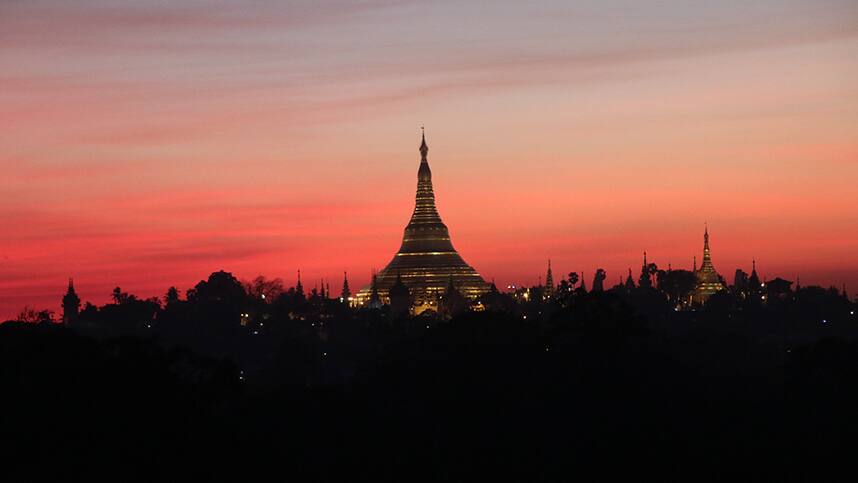
Myanmar
Official Languages: Burmese
Currency: Kyat (MMK)
Time Zone: UTC +6:30 (Myanmar Time)
Traveling to Myanmar?
Whether you’re connecting at the airport or will be exploring what this beautiful country has to offer, you’ll find all the helpful tips you need to know on this page—including the current exchange rate, climate information and more. For detailed country information, please visit the embassy’s website.
Immigration and Visa (For Japanese Nationals Only)
Visa
For citizens of Japan and Korea, Myanmar is implementing a trial visa waiver program beginning October 2018 to November 30th 2020 and continuing.
Applicable travelers
Holders of regular passports from either Japan or Korea.
Period of in effect
Entry into the country between October 1, 2018 and November 30, 2020.
Conditions of visa-free (visa waivered) stay
- The passport must be valid for at least 6 months.
- There must be at least two unused pages for visas remaining in the passport.
- The traveler must hold a valid ticket for departure by air within one month.
- Up to 30 days stay for tourism purposes. Tour guides traveling for tourism purposes are also included.
- Port of entry must be one of Yangon International Airport, Mandalay International Airport, Nay Pyi Taw International Airport, or the water Port of Yangon.
Passport
You may enter if you have a passport that is valid for at least six months from the date of entry.
Quarantine
When visiting from Japan, it is prohibited to bring the following items into Myanmar.
- a. Animals, birds, meat or meat products that do not pass Quarantine, products for animals, animal feed
- b. Live plants, seeds, or soil with no plant Quarantine certificate
- * Items that are deemed in Quarantine to be of nonstandard quality or to contain harmful pathogens or toxins will be confiscated or destroyed.
Immigration Card
As of November 2018, Immigration card is not necessary.
Customs
Bringing electronic cigarettes (heated tobacco) is limited to one device per person for personal (your own) use. In addition, replacement fluid up to 50ml can also be brought with you.
For bringing and possession of tax-free cigarettes
- Liquor: up to 2L
- Tobacco: 400 cigarettes, 50 cigars, or up to 250g of cut tobacco
- Perfumes/eau de Cologne: up to 150ml
Time difference and Daylight Saving Time
Time difference
There is a 2 hour and 30 minute time difference between Japan and Myanmar. Noon in Japan is 9:30 in Myanmar. Daylight saving time is not observed.
Climate
Climate
There are significant regional differences because the country stretches lengthwise north to south. Basically, the central to southern regions are tropical, while the northern region is temperate. The regions in which foreigners can travel without special permission have a hot and humid climate throughout the year.
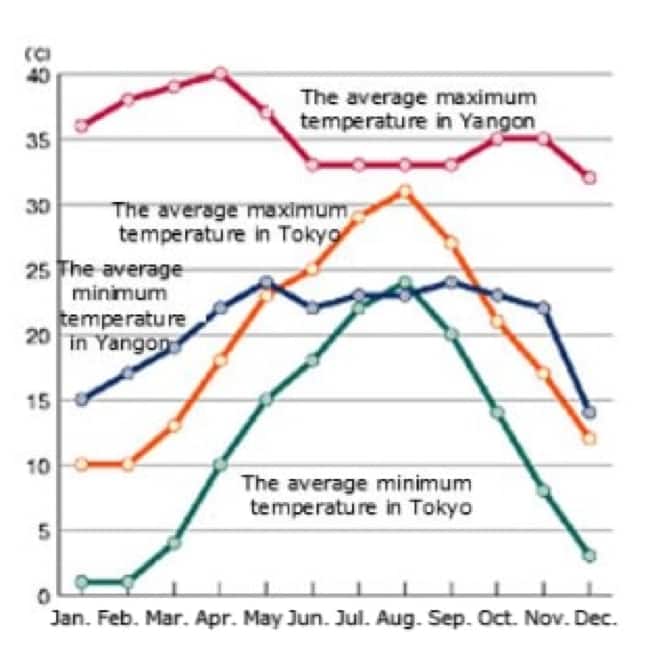
Average Annual Temperature
- * Data on temperature and precipitation in Tokyo is from the Tokyo District Meteorological Observatory. Temperature and precipitation in Yangon is according to data obtained in Myanmar.
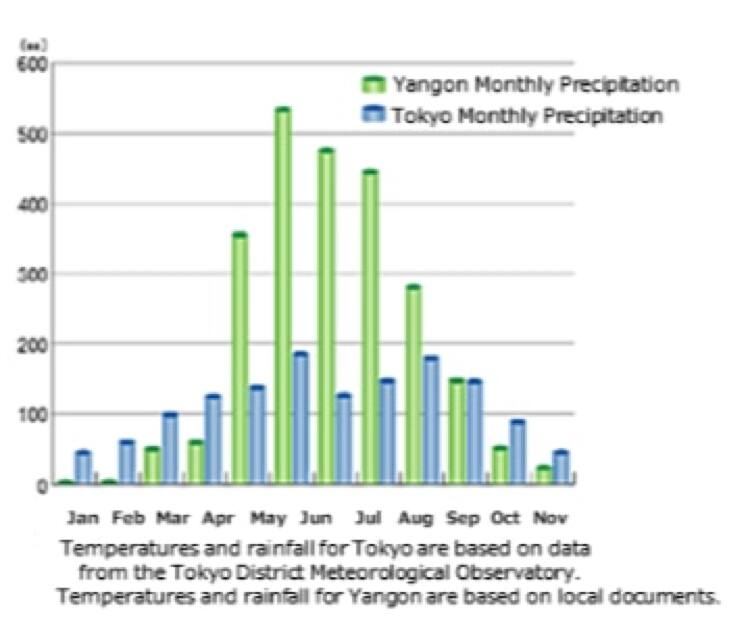
Annual Precipitation
- * Data on temperature and precipitation in Tokyo is from the Tokyo District Meteorological Observatory. Temperature and precipitation in Yangon is according to data obtained in Myanmar.
Currency and Exchange Rate, Tax, Currency exchange, Tip
Currency and Exchange Rate
The unit of currency is the Myanmar kyat. In this website, it is written as K. This is subdivided into pya; 100 pya equals K1. However, the pya is almost never used due to inflation. There are 11 denominations of banknotes: K1, K5, K10, K20, K50, K100, K200, K500, K1000, K5000, and K10000.
Exchange Rate: K1 is approx. JPY0.072. (as of December 3, 2019.)

There are also small new banknotes for the K1000 and K500.
Tax
Luxury hotels will add a 10% tax and a 10% service charge to fees.
Tip
Not required, excluding luxury hotels and upscale restaurants.
Voltage and plug
Voltage
Voltage is 220V to 240V with a cycle of 50Hz. Electric products made to Japanese specifications cannot be used as is. Electric power is inferior, and voltage is unstable. Power failures often occur. Plug types include B, B3, etc.
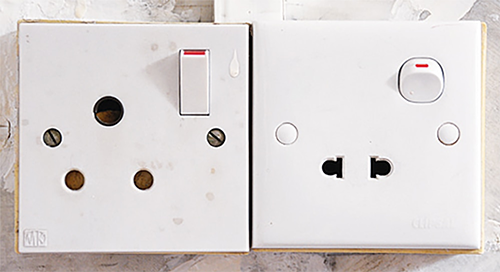
Some plugs have switches that can turn off the power
Video and DVD
Video and DVD
Myanmar used the same NTSC video system as Japan. The DVD region code is 3 (Japan is 2). For Blu-ray Discs, Myanmar uses the same Region A code as Japan.
The postal system has been improved thanks to Japanese assistance. Delivery between Yangon, Naypyidaw, Mandalay has improved significantly from 87.8% in Jan 2014 to 99.3% in Jan 2015.
Postal Fees (airmail to Japan)
A postcard is K500.
Post Office Business Hours
Mon. to Fri. 9:30 to 16:00, Sat. 9:30 to 12:00, closed on Sun./holidays. (may differ according to post office.)
Phone Call
Telephoning Japan from Myanmar
- Dial 00 (International telephone ID Number)
- 81 (Country Code, Japan)
- Other parties telephone number (Remove the first 0 from area codes and mobile telephone numbers)
Telephoning Myanmar from Japan
Use any of the following:
- International Telephone Provider No.
- 001 (KDDI)*1
- 0033 (NTT Communications) *1
- 0061 (SoftBank Telecom) *1
- 005345 (au Mobile) *2
- 009130 (NTT DoCoMo Mobile) *3
- 0046 (SoftBank Mobile)*4
- 010 (International Identification No.)
- 95 (Country Code, Myanmar)
- Other parties telephone No. (Remove the first 0 for area codes and mobile telephone numbers)
-
*1.Not required if you have an international registration with “My Line” or “My Line Plus”. See URL My Line/My Line Plus(www.myline.org) for details.
-
*2.au does not require 005345.
-
*3.Pre-registration to World Wing is required for NTT DoCoMo. Does not require 009130.
-
*4.Call are possible without dialing 0046 from SoftBank.
Myanmar Domestic Calls
Area codes apply and must be placed before any numbers except when making calls within the same area. Line quality can be poor, especially when making calls to other regions.
Myanmar Public Telephones
There are no automatic public telephones as coins are not available. Calls can be made from the public telephone shops available in cities. Telephone usage fees can be paid directly to the teller at each establishment.
Holiday / National holiday
Holiday / National holiday
The dates of national holidays marked with an *1 change each year since they are observed in accordance with the lunar calendar or the Chula Sakarat (Burmese calendar). When a public holiday falls on a Saturday or Sunday, the following Monday is a substitute holiday.
2020
- January 1: New Year's Day
- January 4 to 6: Independence Day
- February 12: Union Day
- March 2: Peasants' Day
- March 8 to 9: Tabaung Festival (full moon in March)*1
- March 27: Armed Forces Day
- April 10 to 17: Maha Thingyan (Water Festival)*1
- May 1: May Day
- May 6: Kason Festival*1
- July 19 to 20: Martyrs' Day
- August 3: Waso Festival (beginning of Buddhist Lent) (full moon in July)*1
- September 29 to October 2: Thadingyut Festival (Also called the Tazaungdaing festival)*1
- November 12: Tazaungmone Festival (full moon in November)*1
- December 25: Christmas Day
- December 31: New Year’s Eve
-
*1.There may be additional Hindu and Islamic holidays.
Language
Language
The official language is Burmese. Ethnic minorities each have their own language. English is understood at many hotels and guesthouses used by foreigners. Chinese is understood in the northern and northeastern regions, and Thai is understood in the eastern region of Shan State.
Business hours, etc
Business hours
Government Offices
Mon. to Fri. 9:30 to 16:30. Closed on Sundays and holidays.
Department Stores/Shops
Business hours vary, because unlike places like Europe, business hours are not public regulated. Generally, stores are open from around 9:00 to 21:00 nearly every day, excluding New Year’s (according to the Burmese calendar) and religious holidays.
Restaurants
Establishments of moderate standing or above are open from around 11:00 to 22:00 or 23:00 (some close for a short period in the afternoon). Some restaurants serving the local residents open at 6:00 or 7:00.
Age Limit
Minors are prohibited from smoking and consuming alcohol.
Manners
Prohibition of Street Shoes on Temple Grounds
In Myanmar, visitors must be barefoot when entering not only temple buildings, but also temple grounds. Socks and stockings, as well as shoes must be taken off. When visiting temples, it is convenient to wear easy-to-slip-off shoes without socks/stockings. Large temples have a place to store shoes at the entrance to the temple approach. Leave a tip when handing over your shoes.
Copyright (C) Globe-Trotter Media Partners Inc. All Rights Reserved.
Copyright (C) Diamond-Big Co., Ltd. All Rights Reserved.