


Traveling to and from Chengdu
On this page, you will find the information you need to easily make your way through Chengdu Shuangliu International Airport to your destination.
Guide to China’s Chengdu Shuangliu International Airport
Arrival and departure terminal maps and other information for navigating Chengdu Shuangliu International Airport.

Arrival Terminal

Airport Map Information
Flights operated by ANA Group will arrive at Terminal 1.
Immigration
Please present your passport and Immigration card.
Customs
Show your Customs declaration form if you have something to declare.
Departure Terminal

Airport Map Information
Flights operated by ANA Group will depart from Terminal 1. Learn more about the Airport Lounge.
Check-In
- Please present your passport and boarding pass.
- Boarding gate check-in counters are subject to change; please check at the airport.
- See ANA International Airport Check-In Counter Opening Times.
Immigration
Please prepare the appropriate half of the re-entry visa form and boarding pass.
Chengdu
On December 19th, 2019 (JST) current information.
Furthermore, the details under "Visa" and "Passport" are for Japanese nationals.
This information is likely to change suddenly, so please contact the relevant official authority (e.g., embassy) for the latest information.

People’s Republic of China
Official Language: Mandarin Chinese
Currency: Renminbi (Yuan)
Time Zone: UTC +8 (China Standard Time)
Travelling to China?
Whether you’re connecting at the airport or will be exploring what this beautiful country has to offer, you’ll find all the helpful tips you need to know on this page—including the current exchange rate, climate information and more. For detailed country information, please visit the embassy’s website.
Immigration and Visa (For Japanese Nationals Only)
Visa
Generally no visa is required for Japanese visitors staying 15 days or less. A visa is required to stay longer than 15 days or if traveling for special purposes. Note that the type of visa varies with the travel purpose. For tourism, obtain a thirty-day tourist visa (L visa).
Passport
Your passport should be valid for at least six months. It should also have at least two unused visa pages.
Quarantine
When visiting from Japan, it is prohibited to bring the following items into China.
Animals and animal products
- a. Live animals (excluding dogs and cats*1)
Includes any mammals, birds, fish, reptiles, amphibians, insects, and other invertebrates and animal genetic material. - b. (Live or aged) meat (including offal), meat products, aquatic animal products.
- c. Animal-derived milk or dairy products
Includes raw milk, fresh milk, yogurt, and animal-derived cream, and other dairy products such as butter and cheese. - d. Eggs or egg products
Includes fresh eggs, preserved eggs, pickled eggs, liquid egg, eggshells, mayonnaise, and other egg-derived products. - e. Swallow's nests (excluding canned)
- f. Oils, fats, skin, furs, hooves, bones, horns, and products made from those items
- g. Animal-derived feed (meat meal, bone meal, fishmeal, whey powder, blood meal, and other single ingredient feed)
Animal-derived herbal medicines, animal-derived feed
-
*1.Each person is only allowed one pet cat or dog with an animal Quarantine certificate and vaccination certificate issued by official organizations from the exporting country (or region)
Plants and botanical specimens
- h. Fresh fruit or vegetables
- i. Tobacco leaves (excluding cut tobacco)
- j. Seeds, seedlings, and other plants with reproductive ability
- k. Organic culture mediums
Other
- l. Bacteria, viruses, or other biological pathogens, noxious insects or other noxious organisms, cells, tissues, organs, blood, or products made from those items or other biological specimens
- m. Animal carcasses, animal specimens, animal-derived waste
- n. Soil
- o. Genetically-modified biological specimens
- p. Other plants, animals, biological specimens, or Quarantine plants or animals that are prohibited from import to the country
- q. Plants or animals that are related to a country (or region) where plant or animal pathogens are spreading
- r. Wastes, radioactive materials, or other items that are not allowed to be brought in to the country
- * Of plants or animals, plant or animal specimens or other Quarantined plants or animals being carried in or sent by mail, those for which a Quarantine certificate has been issued from an official organization from the exporting country (or region) are excluded.
Immigration Card
These cards are on a single form, but are often found separated into halves.
- * Visa, passport, and other information is subject to change without notice. Be sure to check with the Embassy, Consulate, or travel agency.
Customs
Bringing in e-cigarettes
The scope of tax exemption is up to the equivalent of 400 cigarettes of smoking tobacco and an external device worth up to 5,000 yuan.
For bringing and possession of tax-free cigarettes
- Tobacco: 400 cigarettes, 100 cigars, or 500g of cut tobacco
- Liquor: 1.5L of liquor containing over 12% alcohol
Time difference and Daylight Saving Time
Time difference
Japan is 1 hour ahead of Chengdu. Despite the size of the country, China has a single time zone based on Beijing time. Therefore, in reality you may feel another hour of time difference.
Climate
Climate
Possessing land that is approximately 25 times the size of japan. The southwestern part of China is in a subtropical zone, but there are many highlands and high altitude areas and the climate in those places is complex. Note that the clothing you should bring differs by destination.
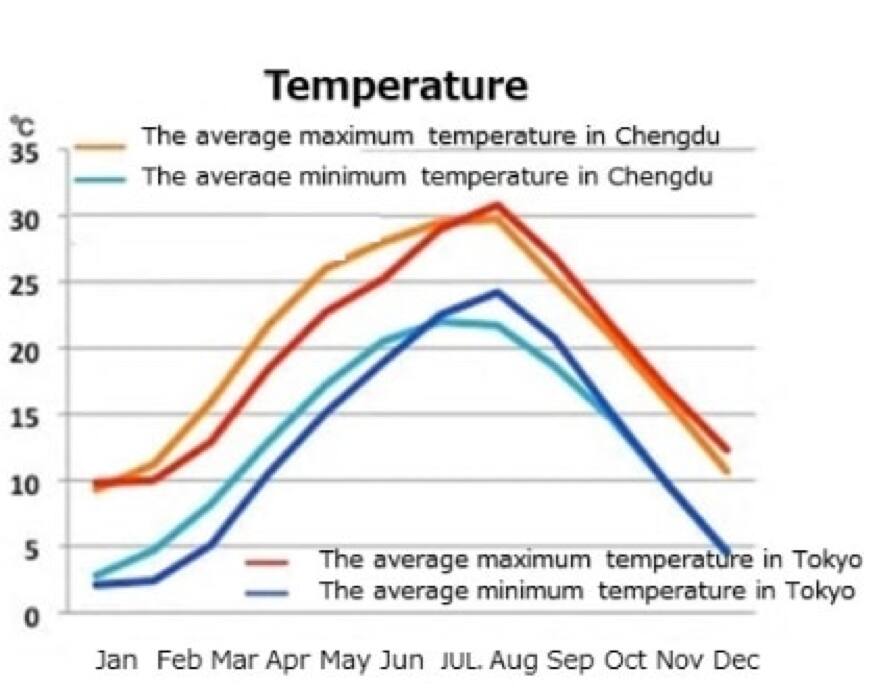
Temperatures in Chengdu and Tokyo
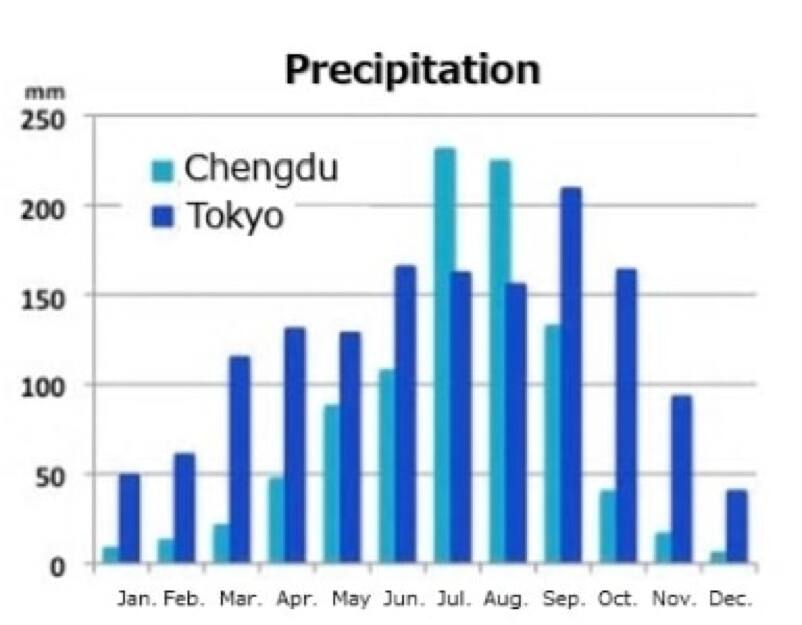
Precipitation in Chengdu and Tokyo
Currency and Exchange Rate, Tax, Currency exchange, Tip
Currency and Exchange Rate
The unit of currency is the Renminyuan (人民元), and is referred to as yuan in Chinese or simply kuai in spoken language. The abbreviation RMB comes from the word Renminbi, which is the same as Renminyuan. The fractional currency units are the jiao (jiao, or mao in spoken language) and the fen. However, the fen is rarely used these days. 1 yuan is 10 jiao, 100 fen, approx. JPY15.36 (as of December 5, 2019). There are 24 denominations of old and new banknotes as well as 10 denominations of coins are in circulation.Primarily distributed banknote denominations are 1 CNY, 10 CNY, 20 CNY, and 100 CNY. 1 CNY coins are also distributed.

Most of the banknotes in distribution are part of a series with Mao Zedong on all notes. From November 2015, new 100-yuan notes printed with forgery prevention technology were issued. The coins in distribution are mostly 1 yuan, 5 jiao, and 1 jiao coins, but these are less common than in the south.
Tax
In China, although taxes (service tax, city maintenance and construction tax, etc.) may be charged when lodging at hotels (not uniform rates). Under the value-added tax (VAT) refund system, you can receive a refund on the VAT when leaving China for purchases of 500 yuan or more at designated stores if you complete the required procedure.
Tip
Tipping is generally not required as there is no custom for tipping in China.(When receiving assistance from a porter, tip about 10 yuan) Service charges are added onto lodging fees at many middle and high class hotels, and tipping is unnecessary in those cases.
Voltage and plug
Voltage
Voltage in China is 220V with a cycle of 50Hz. For this reason, using electronic products from Japan often requires the use of a transformer. There are roughly 7 types of plugs used locally, with type B, C and O being the most common. Transformers and converter plugs can be purchased in Japan at stores selling travel goods as well as large electronic stores, or internet stores selling travel goods.

A multi-nation converter plug is convenient
Video and DVD
Video and DVD
When purchasing video software such as DVD, BD or VCD, take note of both the broadcasting system and the region code. The broadcasting system in Japan is NTSC and China is PAL. To play PAL in Japan, a PAL compatible VCR, video player and TV, or a video player that can convert PAL into NTSC is required (BD is compatible with both). The DVD region code for China is 6 and Japan is 2, and the BD code for China is C and Japan is A (does not apply to VHS and VCD). Although the code for the video software and video player must match in order to be played, it can still be played if either is all-region compatible.
The color of the postal service in China is dark green, so the mailboxes are in dark green, not red. For airmails to Japan, postcards are 5 yuan and sealed letters are 6 yuan (up to 20g) and above.
Phone Call
Telephoning Japan from Mainland China
When calling (03) 1234-5678 or (090) 1234-5678:
- dial 00 (International telephone identification number)
- 81 (Country Code, Japan)
- 3 or 90 (Remove the first 0 for area codes and mobile telephone numbers)
- 1234-5678 (Other parties telephone No.)
Telephoning Mainland China from Japan
- International Telephone Company No.
- 001 (KDDI)*1
- 0033 (NTT Communications) *1
- 0061 (SoftBank Telecom) *1
- 005345 (au Mobile) *2
- 009130 (NTT DoCoMo Mobile) *3
- 0046 (SoftBank Mobile)*4
- 010 (International Identification No.)
- 86 (Country Code, Mainland China)
- Remove the first 0 from telephone numbers for area codes
-
*1.Not required if you have an international registration with "My Line" or "My Line Plus". See URL My Line/My Line Plus(www.myline.org) for details.
-
*2.au does not require 005345.
-
*3.Pre-registration to World Wing is required for NTT DoCoMo. Does not require 009130.
-
*4.Call are possible without dialing 0046 from SoftBank.
- * If you want to stay on the phone you bring from Japan for the three cell phone carriers, hold down 0 until + appears, then add the country code and the phone number your wish to dial.
Holiday / National holiday
Holiday / National holiday
China's national holidays are a combination of the western calendar and the lunar calendar (Chinese calendar), and it should be noted that they include movable holidays that are observed on different dates each year. There are also national holidays and memorial days that fall on specific dates. Additionally, China is a multiethnic nation and there are unique festivals for each ethnic group that are not official holidays but many of which are very interesting to see.
2020
- January 1: New Year's
- January 25: Spring Festival*1
- March 8: International Women's Day*2
- April 4: Qingming Festival*1
- May 1: Labour Day
- May 4: Youth Day*2
- June 1: Children's Day*2
- June 25: Dragon Boat Festival*1
- August 1: Army Day*2
- September 1: Mid-Autumn Festival*1
- October 1: National Day
- * Government approved ways of arranging holidays are announced at the end of the year, and are adjusted yearly.
-
*1.Movable holidays that are observed on different dates each year.
-
*2.National holidays and memorial days that fall on specific dates.
Language
Language
The official language of China is Standard Chinese, a language that was created based on the Beijing dialect of Mandarin which is spoken by China's most dominant majority ethnic group, the Han race. Different ethnic groups have their own official languages. Additionally, even Mandarin which is spoken by multiple ethnic groups is divided into the Northern dialect, Wu (around Shanghai), Min, Yue and Hakka dialects as a result of the large territory of China. Each of these dialects differs so greatly that speakers of differing dialects cannot converse with each other. English is often not understood on the streets.
Business hours, etc
Business hours
Shops and restaurants may differ in hours, but holidays and business hours for public institutions are also not regulated. Below are general guidelines for business hours.
Banks (money exchange)
9:00 to 12:00, 13:30 to 17:00.Closed on Saturday, Sunday and holidays.
Department Stores/Shops
10:00 to 20:00. Open everyday.
Restaurants
11:00 to 15:00, 17:00 to 22:00. Many stores are closed during Spring Festival.
Age Limit
The legal age to obtain a driver's license in China is 18. The law does not restrict the age for drinking and smoking. As of now, there are no rental car systems that can be easily used by travelers.
Copyright (C) Globe-Trotter Media Partners Inc. All Rights Reserved.
Copyright (C) Diamond-Big Co., Ltd. All Rights Reserved.